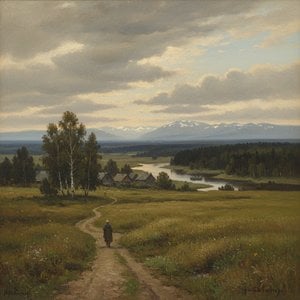
The Echoes of Chernobyl: Unveiling the Art of Arnold Lakhovsky
Born in 1880 amidst the haunting landscape of Chernobyl, Ukraine – a place inextricably linked to both tragedy and resilience – Arnold Borisovich Lakhovsky’s life and art are profoundly shaped by its stark beauty and lingering shadows. Initially known as Aaron Berkovich, his journey from the Russian Empire to Paris and ultimately to New York City represents not just an artistic migration but a testament to the enduring spirit of a displaced artist seeking recognition and expression. His work, often characterized by luminous landscapes and poignant portraits, offers a glimpse into a world grappling with upheaval and searching for beauty amidst uncertainty.
Lakhovsky’s early artistic education laid the foundation for his distinctive style. He began his training at Odessa Art School, absorbing influences from masters like Kostandi and Ladyzhensky. A pivotal period followed in Munich, where he studied under Maro, exposing him to the vibrant colors and expressive techniques of German Impressionism. This exposure proved crucial, shaping his approach to capturing light and atmosphere – a hallmark of his later work. Returning to St. Petersburg, he honed his skills within the workshops of Repin, Tchistyakov, Kiselyov, and Doubovskoy, absorbing diverse artistic philosophies and refining his technical abilities. His time in Palestine, teaching at Bezalel Academy, further broadened his perspective, introducing him to a rich tapestry of cultures and artistic traditions.
A Palette Born of Resilience: Style and Technique
Lakhovsky’s artistic style is immediately recognizable – a captivating blend of Impressionism, Realism, and elements of Ukrainian folk art. He possessed an exceptional ability to capture the fleeting effects of light, particularly in his landscapes, imbuing them with a sense of atmosphere and emotion. His use of color is often vibrant yet nuanced, employing complementary hues to create depth and luminosity. He frequently utilized thick impasto techniques, adding texture and physicality to his canvases, reflecting a deliberate engagement with the surface of the paint itself.
His portraits, equally compelling, are characterized by a remarkable sensitivity to human expression. He wasn’t merely rendering likenesses; he was striving to capture the essence of his subjects – their personalities, emotions, and inner lives. The ‘Self-Portrait,’ a particularly striking example, reveals a confident gaze and an understated elegance, hinting at the artist's own complex character.
From Odessa to Paris: A Journey Through Artistic Circles
Following the Russian Revolution, Lakhovsky’s artistic career took him through various European centers. He spent time in Palestine, teaching art, before relocating to Paris in 1925. Here, he became a member of influential artist groups like the Kouindgi Society and The Wanderers, engaging with a vibrant community of creatives and exhibiting his work at prestigious venues. His relocation to New York City in 1933 marked another significant chapter, where he found employment as a portrait painter and taught at Boston’s School of the Museum of Fine Arts. This period saw him balancing commercial commissions with continued artistic exploration.
Notable Works: Echoes of Place and Emotion
Several of Lakhovsky's paintings stand out for their evocative power and technical mastery. “Fontanka,” a vibrant depiction of St. Petersburg’s canals, exemplifies his ability to capture the shimmering reflections and atmospheric qualities of urban landscapes. The painting’s luminous colors and dynamic composition transport the viewer to the heart of the city. “Girl with a Toy” offers a tender glimpse into childhood innocence, showcasing his skill in portraying human emotion through subtle gestures and expressions. These works, alongside numerous other pieces, reveal a consistent dedication to capturing both the beauty of the world around him and the complexities of the human experience.
A Legacy Forged in Displacement
Arnold Lakhovsky’s life and art are inextricably linked to the historical context of his time – the upheavals of the 20th century, the displacement caused by revolution and war, and the enduring search for identity and belonging. Despite facing numerous challenges, including exile and financial hardship, he persevered in his artistic pursuits, leaving behind a body of work that continues to resonate with viewers today. His paintings serve as poignant reminders of resilience, beauty, and the transformative power of art – echoes of Chernobyl’s landscape imprinted on canvases across continents.