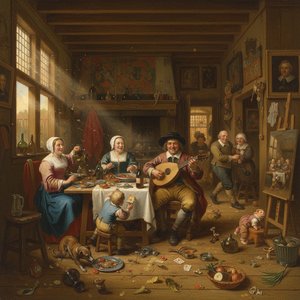
Adriaen Jansz van Ostade: A Master of Dutch Genre Painting
Adriaen Jansz van Ostade (baptized as Adriaen Hendricx van Eyndhoven 10 December 1610 – buried 2 May 1685) stands as a pivotal figure in the history of Dutch Baroque art, celebrated primarily for his poignant depictions of everyday life—specifically peasant scenes and tavern gatherings—that capture the spirit of seventeenth-century Holland with remarkable realism and psychological insight. Unlike many of his contemporaries who pursued grand historical or mythological subjects, Ostade focused on portraying ordinary individuals engaged in commonplace activities, offering a uniquely intimate glimpse into the social fabric of his time.
## Early Life and Artistic Training
Born in Haarlem—a thriving artistic hub—Ostade descended from a family steeped in craftsmanship; his father, Jan Hendricx van Eyndhoven, was a tapestry weaver. This familial connection to textile artistry undoubtedly instilled within him an early appreciation for meticulous detail and visual precision. Crucially, Ostade’s formative years were spent under the tutelage of Frans Hals, arguably Haarlem's most prominent portrait painter, and Isaack Jansz van Ostade, his brother. Hals’s influence is evident in Ostade’s initial stylistic explorations—particularly his penchant for loose brushwork—though he swiftly diverged from Hals’s approach, forging a distinctive path characterized by nuanced observation and expressive rendering.
## Artistic Development and Style
Ostade's artistic journey began with an emulation of Hals’s technique, yet he rapidly cultivated a style that distinguished itself through its remarkable sensitivity to light and shadow—a hallmark of Baroque painting. He eschewed the flamboyant grandeur favored by many artists of his era, opting instead for subdued palettes and carefully crafted compositions that prioritized emotional resonance over ostentation.
His canvases frequently depict scenes of rural life—peasants tending their fields, families celebrating festivals—rendered with painstaking accuracy. Ostade’s masterful use of texture—particularly in portraying fabrics and facial expressions—created a palpable sense of authenticity, transporting viewers into the realities of provincial Holland.
- Ostade's distinctive style is characterized by meticulous detail, subtle chiaroscuro (light and shadow), and an emphasis on capturing expressive faces and gestures.
- He skillfully rendered textures—clothing, objects, environments—creating a profound sense of realism.
## Major Works and Achievements
Among Ostade’s most celebrated paintings are *Saying Grace* (c. 1660), housed at the Cleveland Museum of Art, and *A Laughing Peasant* (1634), residing in the Kremer Collection, Amsterdam—works that exemplify his ability to imbue even humble subjects with dignity and pathos.
His tavern scenes—such as *The Tavern Scene with Musicians*—offer vivid portrayals of social interaction and human emotion, capturing the atmosphere of convivial gatherings with remarkable immediacy.
Ostade’s influence extended beyond his own artistic output; he served as a mentor to several aspiring painters, fostering a vibrant artistic community in Haarlem.
Notably, Jan Steen and Isaac van Ostade were among his pupils—artists who would themselves become recognized masters of genre painting.
## Influences and Legacy
Ostade’s artistic vision was profoundly shaped by Frans Hals’s pioneering approach to portraiture and genre painting. However, he also drew inspiration from David Teniers the Younger, whose paintings reflected the distinct regional characteristics of Brabant—a counterpoint to Ostade's focus on Holland.
More broadly, Ostade’s unwavering commitment to naturalism and psychological realism paved the way for subsequent artistic movements like Impressionism and Realism—demonstrating his enduring relevance as a precursor to modern art.
His paintings continue to captivate audiences today with their evocative depictions of human experience and their masterful execution. Adriaen van Ostade remains an indispensable figure in understanding the cultural landscape of seventeenth-century Holland and the evolution of Western artistic tradition.