Early Life & Artistic Foundations: From Mulhouse to Parisian Satire
Jacques Meyer, known as Henri Meyer and Reyem (6 March 1841, in Mulhouse – 18 July 1899, in Thiais) was a French caricaturist and illustrator; best known for his work with the publishing firm of Hetzel, where he produced engravings for the works of J...
Jacques Meyer, known to the world as Henri Meyer and often signing his work as “Reyem,” emerged from the industrial city of Mulhouse in Alsace, France, in 1841. This seemingly unremarkable beginning belied a career that would become inextricably linked with the burgeoning worlds of adventure literature and pointed social commentary. Unlike many artists who found early patronage within established academic circles, Meyer’s path led him directly into the vibrant, often turbulent arena of Parisian satire. The mid-19th century was a period of intense political upheaval in France, and Meyer quickly discovered his talent for capturing the zeitgeist through sharp wit and incisive illustration. His initial work wasn't focused on grand historical narratives or idealized landscapes; instead, he honed his skills depicting the foibles of French society, particularly targeting the Royalists and Bonapartists who populated its political landscape. This early dedication to caricature wasn’t merely a stylistic choice—it was a deliberate act of resistance, a visual rebellion against the established order.
Illustrating Verne’s Worlds: Meyer's Collaborative Vision with Jules Verne
 Lollichon Field
Experience Paul Gauguin's 'Lollichon Field'! A vibrant Post-Impressionist masterpiece depicting rural French life, now available as a stunning hand-painted reproduction from WahooArt.
Meyer’s career took a defining turn when he began collaborating with Jules Verne and the prestigious publishing firm of Hetzel. This partnership proved to be remarkably fruitful, lasting for decades and solidifying Meyer’s reputation as one of the premier illustrators of his time. Verne's novels—Dick Sand, A Captain at Fifteen and The Indian Frontier among them—were not simply tales of adventure; they were meticulously researched explorations of science, geography, and culture. Meyer didn’t merely *illustrate* these stories; he brought them to life. His engravings weren’t static representations but dynamic interpretations that captured the spirit of Verne's vision. He possessed a unique ability to convey both the grandeur of exotic locales and the intricate details of technological innovation. The success of these collaborations stemmed from a shared commitment to realism, even within the fantastical realms Verne created. Meyer’s illustrations weren’t flights of fancy but grounded depictions that lent credibility to Verne's narratives.
Political Caricature as Social Commentary: 'The Chinese Cake' and Imperial Critique
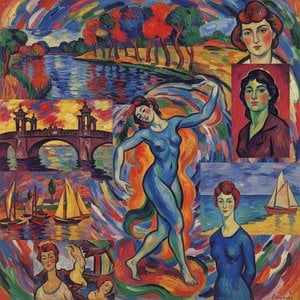
Expressionism is a modernist movement, initially in poetry and painting, originating in Northern Europe around the beginning of the 20th century. Its typical trait is to present the world solely from a subjective perspective, distorting it radically ...
While his work with Verne brought him widespread acclaim, Meyer never abandoned his roots in political caricature. Indeed, these two facets of his career often intertwined, informing each other with a shared sense of observation and critique. Perhaps the most potent example of this is his famous cartoon, “The Chinese Cake.” Created during a period of intense colonial competition among European powers, the image depicts China as a cake being divided by Russia, Great Britain, Germany, and France. The Chinese emperor is shown in a humiliating position, reduced to a mere servant awaiting instructions from the imperial appetites surrounding him. This wasn’t simply a depiction of geopolitical events; it was a scathing indictment of Western imperialism and its exploitative practices. The cartoon's power lay in its simplicity—a readily understandable metaphor that resonated with a broad audience. It served as a visual rallying cry for those critical of colonial expansion, highlighting the inherent injustice and dehumanization at its core.
Meyer’s Technique & Style: Bridging Realism and Expressive Illustration
Henri Meyer's artistic style was characterized by a remarkable blend of realism and expressive illustration. He wasn’t solely concerned with photographic accuracy; rather, he sought to capture the *essence* of his subjects—their character, their environment, their emotional weight. His technique involved meticulous sketching followed by layered engravings that allowed for nuanced detail and dynamic shading. He masterfully employed line work to create a sense of depth and texture, often using cross-hatching and stippling to convey light and shadow. While influenced by the prevailing artistic trends of his time—including elements of Victorian illustration—Meyer developed a distinctive voice characterized by its clarity, precision, and subtle humor. His ability to seamlessly integrate these elements allowed him to create images that were both visually compelling and intellectually stimulating. He wasn’t afraid to exaggerate features or distort perspectives when necessary to emphasize a particular point or evoke a specific emotion.
Legacy and Influence: A Precursor to Modern Graphic Expression
Though often overshadowed by the authors he illustrated, Henri Meyer's contribution to 19th-century art is significant. His work represents a crucial bridge between traditional illustration and the emerging field of modern graphic expression. His political caricatures anticipated many of the themes and techniques that would later define movements like Expressionism, with its emphasis on subjective perspective and social critique. Furthermore, his collaborative spirit—his ability to translate another’s vision into compelling visual form—remains a testament to the power of artistic partnership. Meyer's engravings continue to resonate today not only for their aesthetic qualities but also for their historical significance. They offer a valuable glimpse into the political and cultural landscape of 19th-century France, reminding us of the enduring power of art to challenge authority and provoke thought. At WahooArt.com, we are proud to offer high-quality reproductions of Meyer’s iconic works, allowing you to experience firsthand the artistry and insight of this remarkable illustrator. Explore our collection today and discover the timeless appeal of Henri Meyer's vision.