Victor Vasarely: Pioneer of Op Art and Democratizing Visual Experience
Victor Vasarely (1906-1997), born Győző Vásárhelyi in Pécs, Croatia, stands as a monumental figure in the history of 20th-century art. More than just an artist, he was a visionary who fundamentally reshaped our understanding of perception and challenged conventional artistic boundaries—a legacy that continues to resonate powerfully within contemporary design and visual culture.
His journey began with aspirations for medicine but swiftly pivoted towards the expressive potential of painting after enrolling at Sándor Bortnyik’s Műhely academy in Budapest. This formative experience instilled him with a core belief: art should strive to communicate ideas beyond mere representation, embracing geometric abstraction and exploring the subconscious realm.
The Bauhaus influence was decisive. Bortnyik's school championed functional design alongside artistic experimentation—a crucible where Vasarely honed his skills in constructing visual illusions using precise mathematical principles. This dedication to rational structure would become the bedrock of his distinctive Op Art style, a movement that sought to stimulate retinal stimulation and create mesmerizing optical effects.
The Birth of Op Art: Geometric Abstraction and Illusion
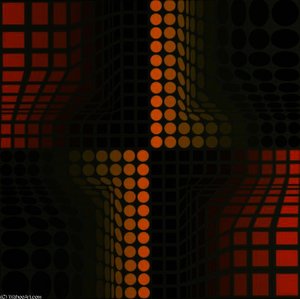
Op Art—short for Optical Art—emerged in the mid-1960s as Vasarely spearheaded its development. Rejecting traditional painting techniques, he employed repetitive geometric patterns – circles, squares, triangles – arranged in seemingly random configurations. However, these patterns weren’t merely decorative; they actively tricked the eye into perceiving movement and depth where none existed.
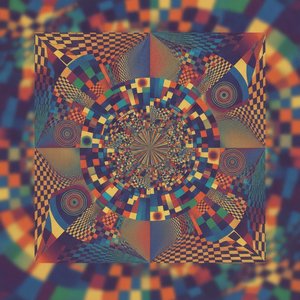
"Pauk 101," a vibrant example of this style, exemplifies Vasarely's meticulous approach. The photograph captures the painting's intricate chromatic interplay—reds, greens, blues, yellows, and purples converge in harmonious yet unsettling patterns. Each element contributes to an illusionary space that defies Euclidean geometry, prompting viewers to question their sensory experience.
A System of Artistic Exploration
Vasarely didn’t simply stumble upon Op Art; he developed a systematic methodology based on mathematical formulas and visual perception research. He meticulously calculated the spacing between shapes and explored how these parameters influenced the resulting optical illusion. This intellectual rigor distinguishes him from many other artists of his time, elevating his work beyond mere aesthetic pleasure to a profound investigation into the nature of consciousness.
His artistic system—characterized by “geometric dominoes”—was designed to generate infinite variations while maintaining fundamental principles. Vasarely believed that art could democratize visual experience, making complex concepts accessible through simple geometric forms. This conviction fueled his prolific output and cemented his position as a pioneer of kinetic art.
Legacy and Influence
Victor Vasarely’s impact extends far beyond the realm of painting. His pioneering approach to abstraction influenced graphic design, interior decoration, and even fashion—demonstrating the enduring power of geometric principles to communicate ideas effectively. Reproductions of “Pauk 101,” like those offered on WahooArt.com, allow collectors and enthusiasts alike to appreciate the brilliance of Vasarely’s vision and experience firsthand the captivating allure of Op Art.



 Представи си го
 Купете ръчно рисувана картина
 Изпрати
 Сподели
 Детайли

 Изтегляне
 Подобни
 Рентгенова снимка
 Слайдшоу
 Статистика

 Прочетете повече






































 Стъклото е налично само в размери под 110 см