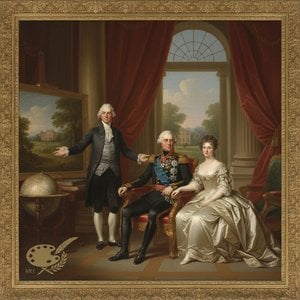
Mary du Cane, née Norris: A Portrait of Quiet Dignity
Arthur William Devis’s “Mary du Cane, née Norris” stands as a testament to the understated elegance characteristic of Georgian portraiture and, crucially, embodies the burgeoning fascination with capturing psychological depth within formal depictions. Painted in 1749, this canvas offers more than just a likeness; it presents an intimate glimpse into the life and character of Mary Du Cane herself – a woman whose quiet dignity radiates from the canvas.
Devis’s stylistic approach aligns perfectly with the prevailing trend of “conversation pieces,” which sought to portray subjects engaged in domestic activities or contemplating philosophical ideas. Unlike grand historical narratives, these portraits prioritized conveying emotion and capturing the subtleties of human experience. Here, Mary Du Cane is seated gracefully on a chair draped in rich fabrics—a deliberate choice reflecting the social status of her family.
The artist skillfully blended light and shadow to sculpt form and create a sense of three-dimensionality. The glazing techniques employed by Devis ensured luminous colors and subtle tonal variations that enhanced the realism of Mary’s features and drapery. This meticulous attention to detail speaks volumes about Devis’s commitment to artistic excellence.
Beyond its aesthetic merits, “Mary du Cane, née Norris” resonates with a profound emotional impact. It invites contemplation on themes of femininity, grace, and inner resilience – qualities valued within Georgian society. The painting's enduring appeal lies in its ability to capture not just a woman’s appearance but also her spirit—a remarkable achievement for Devis and a cornerstone of Georgian portraiture’s legacy.
Arthur William Devis: A Provincial Eye on Georgian Life
Born in London in 1762, Arthur William Devis descended from a family distinguished by artistic talent. Following in the footsteps of his elder brother Thomas Anthony Devis—also a painter—he pursued formal training at Westminster School and later apprenticed under John Raphael Smith, a prominent Flemish topographical artist.
Smith’s influence undoubtedly shaped Devis's technique, fostering an appreciation for meticulous observation and skillful rendering. However, Devis swiftly transitioned to portraiture, establishing himself as a respected artist within the provincial circles of England. His success wasn’t meteoric; rather, it was built upon consistent dedication and a keen understanding of his patrons’ desires.
Devis's oeuvre encompasses both historical subjects and intimate portraits—a duality that reflects the broader artistic currents of his time. He gained particular renown for his depictions of naval life, notably “The Death of Nelson,” which powerfully conveyed emotion and commemorated a pivotal moment in British history. This monumental canvas exemplifies Devis’s ability to transform visual representation into an instrument of commemoration.
Conversation Piece Portraiture: Capturing Character & Emotion
Devis's work aligns seamlessly with the broader trend of “conversation piece” portraiture—a genre that flourished during the Georgian era. Artists like Devis recognized that true artistry lay not merely in replicating appearances but in capturing psychological depth and conveying emotion.
This approach demanded a nuanced understanding of human behavior and an ability to translate inner states into visual form—a challenge that Devis embraced wholeheartedly. He skillfully utilized glazing techniques to achieve luminous colors and subtle tonal variations, enhancing the realism of his subjects’ expressions and creating a palpable sense of atmosphere.
Symbolism & Context: Reflecting Georgian Values
“Mary du Cane, née Norris” embodies the values prevalent during the Georgian period—a time characterized by aristocratic refinement and an emphasis on social decorum. The chair draped in luxurious fabrics symbolizes familial status and wealth, while Mary’s gaze directs towards the viewer establishing a connection of respect and composure.
The artist's meticulous attention to detail—particularly in rendering Mary’s drapery—demonstrates Devis’s mastery of technique and underscores his commitment to conveying not just physical likeness but also inner character. The painting serves as a poignant reminder of Georgian artistic ideals – where beauty, grace, and psychological insight were paramount.



 Преглед в реален мащаб
 Поръчайте ръчно рисувано репродукция на този колекционерски предмет
 Сподели
 Сподели
 Подробности
 Ръководство

 Изтегляне
 Подобни артикули
 Рентгенова снимка
 Слайдшоу
 Статистика


 Разгърни целия текст






































 Опцията със стъкло е налична само за размери под 110 см