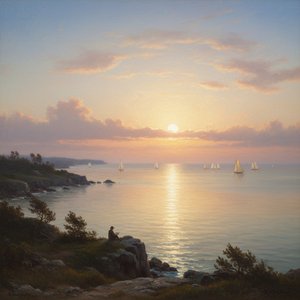
A Legacy Rooted in Tradition: The Art of Wu Hufan
Wu Hufan, a contemporary artist whose work resonates deeply with the spirit of traditional Chinese painting and calligraphy, stands as a compelling figure bridging past and present. While biographical details remain intentionally focused on his art itself – reflecting a common practice within certain East Asian artistic circles prioritizing the work over extensive personal narrative – it is clear that Wu Hufan’s dedication lies in upholding and evolving centuries-old techniques and philosophies. He doesn't simply *reproduce* tradition; he embodies it, infusing each brushstroke with a reverence for his ancestors while simultaneously forging a uniquely modern expression. His paintings are not merely images but meditations on nature, morality, and the very essence of artistic creation.
The Language of Mountains and Water
Wu Hufan’s oeuvre is dominated by *shan shui* (mountain-water) landscapes, a genre central to Chinese painting since the Tang Dynasty. However, his approach isn't one of imitation but rather of deeply internalized understanding. He doesn’t paint what he *sees*, but what he *feels* when immersed in nature – the weight of ancient peaks, the fluidity of rivers, the subtle play of mist and light. His compositions often feature towering mountains shrouded in atmospheric haze, suggesting both grandeur and ephemerality. Pine trees, symbols of longevity and resilience, frequently appear, their gnarled branches reaching towards the heavens as metaphors for perseverance and spiritual aspiration. The use of ink is masterful; he employs a range of tones – from delicate washes to bold, expressive strokes – to create depth, texture, and a sense of dynamic movement. His landscapes are not static representations but living, breathing entities that invite contemplation and evoke a profound connection with the natural world.
Calligraphy as Painting, Painting as Calligraphy
Equally significant in Wu Hufan’s artistic practice is his calligraphy. He specializes in *xingshu* (semi-cursive) script, known for its fluidity and expressive character. For Wu Hufan, calligraphy isn't a separate discipline from painting but an integral part of it. Often, he incorporates poetic inscriptions into his landscapes, seamlessly blending the visual arts with literature. These poems, typically inspired by classical Chinese verse, add layers of meaning to his paintings, enriching their narrative and philosophical depth. He views the brushstroke itself as embodying energy and spirit – whether applied to paper for calligraphy or canvas for painting. The control, rhythm, and intention behind each stroke are paramount, reflecting a deep understanding of both form and content.
The interplay between ink, brush, and paper becomes a performance of inner cultivation.
Influences and Artistic Lineage
While specific teachers or mentors aren’t prominently documented, Wu Hufan's work clearly demonstrates a profound engagement with the traditions of the Four Wang school (Wang Wei, Wang Meng, Wang Yun, and Wang Jian), renowned for their meticulous brushwork and scholarly approach to landscape painting. He also draws inspiration from the literati painters of the Ming and Qing dynasties, who emphasized self-expression and philosophical contemplation in their art.
His work isn’t a direct copy of any single master but rather a synthesis of various influences, filtered through his own unique sensibility. It's a testament to his deep study of Chinese art history and his ability to absorb and transform traditional elements into something new and personal. He embodies the spirit of continuing a lineage while simultaneously innovating within it.
A Contemporary Voice in an Ancient Tradition
Wu Hufan’s significance lies not only in his technical mastery but also in his commitment to preserving and revitalizing traditional Chinese art forms in a rapidly changing world. His paintings offer a sanctuary from the noise and chaos of modern life, inviting viewers to reconnect with nature, contemplate their own inner selves, and appreciate the beauty and wisdom of ancient traditions.
- He represents a continuation of the scholar-artist tradition.
- His work embodies a harmonious balance between technical skill and spiritual expression.
- Wu Hufan’s art serves as a bridge between past, present, and future generations.
In an era often dominated by Western artistic trends, Wu Hufan stands as a powerful reminder of the enduring beauty and relevance of Chinese culture. His paintings are not simply works of art; they are windows into a rich and profound artistic heritage, offering timeless insights into the human condition and our relationship with the natural world.