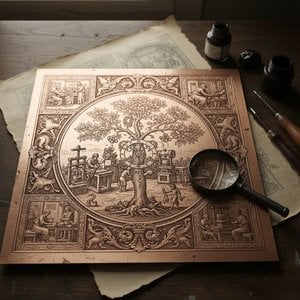
Wolfgang Werkmeister: A Portrait of Brechtian Expression
Wolfgang Werkmeister (1941 – Present) stands as a singular figure in German etching and drawing, recognized for his unwavering dedication to capturing profound emotion through meticulous technique. Born in Berlin during the formative years of postwar Germany, Werkmeister’s artistic journey began at Stuttgart Academy of Fine Arts in 1960, where he honed his skills and established himself as a master of printmaking—specifically, etching—a medium that would become synonymous with his distinctive style. Werkmeister's oeuvre is profoundly shaped by the intellectual currents of Bertolt Brecht, whose theatrical innovations championed alienation and critique – concepts Werkmeister consistently translated into visual representations. This influence manifests most notably in his iconic portrait of Brecht (1976), a lithograph executed with painstaking detail and imbued with an atmosphere of melancholic contemplation. The heavy lines and subdued tonal palette convey not merely likeness but also the psychological depth characteristic of Brecht’s dramatic vision. It's a piece that invites viewers to consider the complexities of human experience alongside artistic interpretation. Werkmeister’s artistic development progressed steadily throughout his career, marked by an exploration of diverse subjects—portraits, landscapes, and still lifes—all rendered with remarkable precision and sensitivity. He consistently prioritized capturing subtle nuances of emotion and gesture, demonstrating a profound understanding of how visual elements could communicate ideas beyond mere representation. His work transcends stylistic trends, prioritizing conceptual integrity and emotional resonance above all else. Throughout his prolific output, Werkmeister achieved considerable acclaim within the German art world. Exhibitions across Europe showcased his talent and solidified his reputation as one of Germany’s foremost printmakers. He continues to practice actively today, demonstrating an enduring passion for his craft and a commitment to pushing the boundaries of etching technique. His legacy resides not only in the beauty of his artworks but also in their unwavering faithfulness to Brechtian principles—a testament to the power of art as a vehicle for intellectual engagement and emotional expression.- Key Influences: Bertolt Brecht’s theatrical philosophy, Expressionism
- Notable Achievements: Numerous solo exhibitions throughout Europe; Recognition as a master of etching technique.
- Signature Style: Detailed portraits and landscapes characterized by heavy lines and melancholic mood; Emphasis on conveying psychological depth.