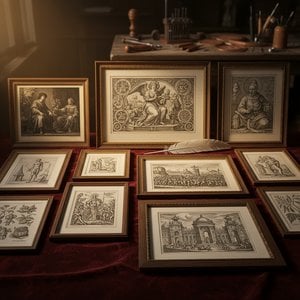
Wilhelm Pleydenwurff: The Architect of Nuremberg’s Visual Narrative
Wilhelm Pleydenwurff (1460 – 1494), born in Nuremberg, Germany, stands as a pivotal figure in the burgeoning Renaissance art scene and arguably the most influential artist responsible for shaping the visual representation of his era. His legacy rests primarily on his monumental contribution to the Nuremberg Chronicle—a lavishly illustrated history book that cemented Nuremberg’s position as a cultural powerhouse and profoundly impacted European artistic conventions. While biographical details remain scarce, scholarly research paints a portrait of a skilled craftsman deeply embedded in the vibrant intellectual currents of his time.Early Life and Artistic Training
Information regarding Wilhelm Pleydenwurff's formative years is fragmentary. He descended from a family renowned for its artistic prowess—his father, Hans Pleydenwurff, operated a substantial painting workshop in Nuremberg since 1457, fostering an environment ripe for artistic development. Evidence suggests that Wilhelm received his initial training within this familial atelier alongside Michael Wolgemut, who would later become his stepfather and collaborator on the celebrated Nuremberg Chronicle. This partnership established a crucial connection between two masters of German printmaking and illuminated manuscript illustration—a symbiosis that exemplifies the collaborative spirit characteristic of Renaissance art.The Nuremberg Chronicle: A Monumental Achievement
Pleydenwurff’s fame derives almost entirely from his involvement in the creation of Albrecht Dürer's *Schedel’s World Chronicle*, begun in 1493 and completed shortly before his untimely death. This ambitious project aimed to encapsulate the entirety of human history—from Genesis to Luther—through meticulously crafted woodcuts and gilt illuminations. Pleydenwurff’s contribution was transformative, elevating the chronicle's visual impact beyond anything previously achieved. His mastery of wood engraving technique—characterized by precise linework and subtle tonal gradations—established a new standard for printmaking accuracy and artistic sophistication. The intricate detail and expressive dynamism of his scenes captivated audiences across Europe and profoundly influenced subsequent generations of artists. Notably, he collaborated closely with Wolgemut on the project, demonstrating a shared commitment to pushing the boundaries of artistic innovation.Technique and Artistic Style
Pleydenwurff’s artistic style is defined by an unwavering dedication to realism combined with a masterful understanding of perspective—a technique pioneered by Brunelleschi and enthusiastically embraced by Dürer himself. His woodcuts exhibit exceptional precision, capturing minute anatomical details and conveying emotional nuance through subtle shading effects. Unlike many contemporary artists who favored stylized representations, Pleydenwurff prioritized faithful depictions of historical events and biblical narratives, reflecting the humanist ideals prevalent during his lifetime. He skillfully employed hatching and crosshatching to create depth and texture—techniques that would become hallmarks of German Renaissance printmaking.Legacy and Historical Significance
Wilhelm Pleydenwurff’s influence extends far beyond the Nuremberg Chronicle. His groundbreaking approach to wood engraving established a precedent for future artists, shaping the stylistic conventions of German printmaking for decades to come. Furthermore, his contribution to the chronicle solidified Nuremberg's reputation as a center of artistic excellence—a testament to the enduring power of collaborative creativity and unwavering commitment to mastering technical skill. Though his life was tragically cut short, Pleydenwurff’s legacy persists in the breathtaking beauty and intellectual depth of his artwork—a timeless reminder of the transformative potential inherent within Renaissance art.- Explore the impactful Renaissance art of Wilhelm Pleydenwurff, renowned for his detailed Nuremberg Chronicle engravings & German historical depictions.