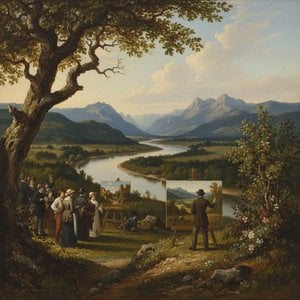
Paul Gauguin: A Rebel’s Palette
Paul Gauguin, born Eugène Henri Paul Gauguin in 1848 amidst the tumultuous year of revolutions across Europe, was an artist whose life and work defied convention. He wasn't merely a painter; he was a restless spirit, a seeker of authenticity, and a provocateur who fundamentally altered the course of modern art. His journey, marked by financial struggles, exotic sojourns, and a relentless pursuit of a primal artistic vision, culminated in a body of work that continues to captivate and challenge viewers today. Initially trained as a stockbroker, Gauguin’s passion for art ignited during his early years, fueled by visits to Parisian galleries and an innate desire to escape the constraints of bourgeois society. This initial foray into the art world was largely self-directed, shaped more by observation and association than formal academic training – a crucial distinction that would later define his unique style.
Early Influences and the Impressionist Phase
Gauguin’s artistic development began within the vibrant milieu of Parisian Impressionism. He encountered Camille Pissarro, a leading figure in the movement, who became a mentor and provided crucial guidance during the 1870s and early 1880s. Gauguin participated in the first four Impressionist exhibitions, producing works depicting scenes of Parisian life – bustling markets, cafes, and intimate interiors. However, he soon found himself increasingly dissatisfied with the limitations of Impressionism’s focus on capturing fleeting moments of light and color. While appreciating the movement's innovations, Gauguin felt a deeper need to express something more profound—a yearning for spiritual truth and an exploration of the human condition beyond mere visual representation. This desire led him away from the bright palette and ephemeral scenes of his early work towards a bolder, more symbolic approach.
Tahitian Visions: A Search for Paradise
In 1893, Gauguin embarked on a transformative journey to Tahiti, then a French colony in the South Pacific. This move was not merely an escape but a deliberate attempt to find a “primitive” paradise—a place untouched by Western civilization where he could create art rooted in authentic experience and unburdened by European conventions. The vibrant colors of Tahiti, the exotic flora and fauna, and the captivating culture of the native population profoundly influenced his work. Paintings like *Vision of Iao*, *The Vision of Nafea Faatima’s Window* and *Atan* showcase this shift—bold, saturated hues dominate, depicting scenes of Tahitian life imbued with a sense of mystery and spirituality. However, Gauguin's time in Tahiti was far from idyllic. He struggled to establish himself as an artist, faced cultural misunderstandings, and battled declining health, ultimately leading to his departure for the Marquesas Islands in 1895.
The Symbolist Style and Late Works
During his years in the Marquesas Islands, Gauguin developed a distinctive style that combined elements of Impressionism, Post-Impressionism, and Symbolism. He employed flattened perspectives, simplified forms, and intensely symbolic imagery to convey emotional states and spiritual ideas. His brushstrokes became increasingly vigorous and expressive, creating a sense of dynamism and immediacy. The late paintings from this period—*Where Do We Come From? What Are We? Where Are We Going?*, *Death Marshals*, and *Illusion*—are particularly powerful examples of his Symbolist vision. These works explore themes of mortality, spirituality, and the human condition with a raw intensity that reflects Gauguin’s personal struggles and philosophical inquiries. The use of vibrant colors, often juxtaposed in unexpected ways, creates a dreamlike atmosphere, inviting viewers to contemplate profound questions about existence.
Legacy and Influence
Paul Gauguin's impact on the art world is undeniable. He challenged traditional notions of representation, paving the way for Expressionism and other avant-garde movements. His bold use of color, simplified forms, and symbolic imagery profoundly influenced artists such as Vincent van Gogh, Henri Matisse, and Pablo Picasso. While initially met with criticism and controversy, Gauguin’s work has since been recognized as a cornerstone of modern art—a testament to his unwavering commitment to artistic innovation and his willingness to defy convention in pursuit of his unique vision. His legacy continues to inspire artists today, reminding us of the power of art to explore the depths of human experience and challenge our perceptions of reality.