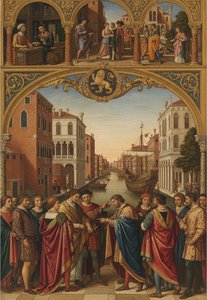
Vittore Gambello (1460–1537): Venetian Sculptor and Master of Relief
Vittore Gambello, born circa 1460 in Venice, Italy, stands as a pivotal figure within the Venetian Renaissance artistic landscape. His legacy rests primarily on his groundbreaking contributions to sculptural technique—specifically, his pioneering method for stamping medals—a revolutionary approach that fundamentally altered the production of commemorative coinage and cemented his reputation as an innovator.
Gambello’s formative years were marked by a profound engagement with the artistic currents circulating in Venice during Bellini's time. Studying under Giovanni Bellini instilled in him a meticulous attention to detail and a deep understanding of expressive painting, influences that would permeate his subsequent sculptural endeavors. This early training established a foundation for mastering the complexities of portraying human form and conveying emotion through sculpted surfaces.
His career began with employment at the Venetian Mint where he swiftly ascended to Maestro della Stampe—the role of chief engraver—a position he held until his death in 1537. Recognizing the limitations of traditional casting methods, Gambello devised a novel technique that utilized pressure and punches to transfer designs onto metal plates, resulting in medals bearing remarkably high relief. This innovation dramatically increased production volume while simultaneously elevating artistic quality.
Gambello’s oeuvre encompasses both sculptural commissions and medal designs—a testament to his versatility as an artist. Notable works include depictions of Saint Vitore and Carlo Basilica in Genoa and the monumental statue of St. Peter in Piazza San Pietro, Rome. His sculptures are characterized by a serene grace and masterful execution, reflecting Bellini's influence and demonstrating Gambello’s ability to capture idealized beauty.
Among his most celebrated achievements is undoubtedly “Seated Hercules Shooting at the Stymphalian Birds,” a monumental bronze sculpture housed in the Cleveland Museum of Art. This artwork exemplifies Gambello’s mastery of relief carving, skillfully conveying dynamism and narrative tension through intricate detailing and balanced composition. The depiction captures the heroic posture of Hercules as he unleashes his arrow against the monstrous birds—a scene imbued with symbolic significance reflecting themes of courage and triumph.
Furthermore, Gambello's contribution to Venetian art history extends beyond individual masterpieces. He helped establish a new standard for sculptural technique, influencing subsequent generations of artists and solidifying Venice’s position as a center of artistic innovation during the Renaissance. His legacy continues to inspire admiration for his pioneering spirit and unwavering dedication to elevating the craft of sculpture.