A Florentine Chronicler of Elegance: The Life and Art of Tito Conti
Tito Conti, born in Florence in 1842 and passing away in 1924, was a painter deeply embedded in the artistic traditions of his city. While not a revolutionary figure, Conti carved out a significant niche for himself as a master of genre painting, particularly scenes depicting historical costumes and refined domestic life. He wasn’t striving to redefine art; rather, he excelled at capturing a specific moment—the late 19th century—with meticulous detail and an undeniable sense of style. His early training took place within the Institute of Fine Arts in Florence, laying the foundation for his technical prowess and appreciation for classical aesthetics. Conti quickly established himself as a resident professor at the Academic College of Fine Arts of Florence, demonstrating not only artistic skill but also a capacity to nurture talent in others; among his pupils was Arturo Ricci.
The Allure of Detail: Themes and Techniques
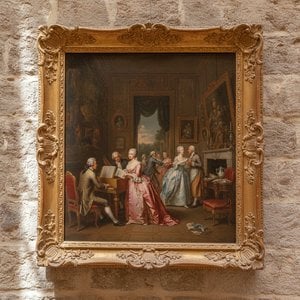
Conti’s oeuvre is characterized by an exquisite attention to detail—a hallmark of his work that immediately draws the viewer into the scene. He favored subjects steeped in narrative, often portraying intimate moments within affluent Florentine households or recreating scenes from historical literature. Paintings like *La Presentazione*, *Il quarto d'ora di Rabelais e La musica* (1876), and *Per la passeggiata* (1886) exemplify this focus. He wasn’t merely documenting events; he was constructing a world of beauty, luxury, and social grace. His technique involved a delicate layering of color, creating a pearlescent sheen that enhanced the richness of fabrics, furniture, and skin tones. This meticulous approach extended to his depictions of light and shadow, lending depth and realism to his compositions. He possessed an ability to render textures with remarkable accuracy—the rustle of silk, the gleam of polished wood, the softness of a woman’s hair—all contributing to the immersive quality of his paintings.
A Collector's Perspective: Recognition and Critique
Conti’s work garnered attention from contemporary art collectors, including the American James Jackson Jarves, who recognized his talent but also offered a nuanced critique. While praising Conti’s “more refinement and higher artistic culture” compared to some of his peers—specifically Francesco Vinea and Edoardo Gelli—Jarves noted that his technical skill sometimes overshadowed the emotional depth of his subjects. He famously commented that Conti "paints too well for his subject," suggesting that his execution surpassed the inherent drama or complexity of the scenes he depicted. This observation highlights a key aspect of Conti’s artistic identity: he was, first and foremost, a skilled craftsman whose mastery of technique sometimes eclipsed the narrative power of his work. Nevertheless, this very skill made him highly sought after by Florentine high society, who appreciated the refined elegance and flattering portrayals in his portraits.
Legacy and Influence
Although not widely known today, Tito Conti played an important role in preserving a particular vision of 19th-century Italian life—a world of ornate interiors, fashionable attire, and subtle social interactions. His paintings offer a valuable glimpse into the tastes and values of the Florentine elite during this period. In 1939, his wife, Maria Conti, established an artist in residence at the Academy of Arts of Design in Florence, ensuring that his legacy would continue to support emerging talent. This act underscores her belief in the importance of artistic education and her desire to perpetuate her husband’s memory through a tangible contribution to the art world. While he may not have been a groundbreaking innovator, Tito Conti remains a compelling figure—a skilled painter who captured the beauty and refinement of his time with exceptional technical ability and an enduring sense of style.
Selected Works
La Presentazione
Il quarto d'ora di Rabelais e La musica (1876)
Il brindisi alla bettoliera
L’addio
Portrait of his wife
Il sospetto
Il Cantastorie
Il Moschettiere
Per la passeggiata (1886, Florence)
بقلم فريق تحرير WahooArt.com
اختبار الفنون
يوجد إجابة صحيحة واحدة فقط لكل سؤال.
سؤال 1:
Where was Tito Conti born and where did he primarily live and study?
سؤال 2:
What were Tito Conti's primary subjects as a painter?
سؤال 3:
Who was one of Tito Conti's notable pupils?
سؤال 4:
According to James Jackson Jarves, what was a strength of Conti's painting?
سؤال 5:
In what year did Conti exhibit 'Il quarto d'ora di Rabelais e La musica'?
Explore the profound beauty of genre painting. From Dutch Golden Age masters to global traditions, discover how artists capture the essence of everyday life through masterful realism and timeless storytelling.