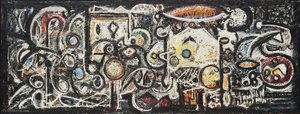
Richard Pousette-Dart: A Landscape of the Soul
Born in St. Paul, Minnesota, in 1916, Nathaniel Jermund Pousette-Dart—later known simply as Richard Pousette-Dart—emerged from a family steeped in artistic tradition to become one of the pivotal figures of the New York School of Abstract Expressionism. His journey wasn’t merely a progression through art movements; it was a deeply personal exploration, translating the landscapes and emotional currents of his life onto canvas with an arresting combination of geometric precision and evocative color. From humble beginnings—the son of Swedish immigrants who hyphenated their last names as a symbol of mutual respect—Pousette-Dart’s career unfolded against the backdrop of a rapidly changing American art scene, marked by both experimentation and a yearning for universal expression.
His early years were shaped by his parents' artistic pursuits. His father, Nathaniel Pousette, was a painter and art writer who championed modernist American art through his publications, while his mother, Flora Dart, fostered an environment of creativity and intellectual curiosity, hosting poetry salons and exploring alternative spiritualities. This upbringing instilled in Richard a profound appreciation for both the formal elements of art and its potential to convey deeper meaning. He began painting at age eight, honing his skills under the guidance of Robert Henri at the Art Students League in New York City and Philadelphia, absorbing the principles of Impressionism while simultaneously developing an independent vision.
Early Influences and Artistic Development
Pousette-Dart’s artistic development was profoundly influenced by a confluence of factors. His exposure to European avant-garde movements—particularly Cubism and Surrealism—during his time in New York City ignited a desire to break free from representational constraints. Simultaneously, he found inspiration in the art of indigenous cultures, particularly Northwest Coast Native American carvings, which captivated him with their symbolic power and geometric complexity. This fascination led him to study these forms extensively, incorporating their principles into his own work—a deliberate move away from purely Western artistic traditions.
A crucial turning point came through his friendship with John D. Graham, a Russian émigré philosopher and art critic whose writings on myth, symbolism, and the unconscious mind resonated deeply with Pousette-Dart’s evolving aesthetic. Graham encouraged him to explore archetypal forms and universal themes, pushing him toward a more profound engagement with the emotional core of his art. This intellectual dialogue, combined with his practical experience as an assistant to sculptor Paul Manship and a secretary for photographic retouching studio owner Lynn T. Morgan, provided him with invaluable insights into composition, color theory, and the interplay between form and space.
The Emergence of Biomorphic Forms
By the late 1930s and early 1940s, Pousette-Dart began to develop his signature style—characterized by a distinctive use of biomorphic forms. These weren’t simply abstract shapes; they were imbued with symbolic weight, often evoking natural elements like plants, animals, and celestial bodies. He employed a meticulous approach to composition, utilizing precise geometric structures to create a sense of balance and harmony while simultaneously allowing for an underlying dynamism and tension. His use of color was equally deliberate, ranging from muted earth tones to vibrant hues that seemed to pulse with inner light.
A defining moment in his career came with the creation of *Woman Bird Group* (1943), a monumental canvas now housed at the Smithsonian American Art Museum. This work—alongside others like *Desert* and *Presence, Ramapo Horizon*—demonstrates Pousette-Dart’s ability to synthesize disparate influences into a cohesive and deeply expressive style. These paintings weren't merely decorative; they were explorations of consciousness, spirituality, and the relationship between humanity and nature.
Legacy and Historical Significance
Richard Pousette-Dart’s contribution to American art is undeniable. He was a key figure in the New York School, alongside artists like Jackson Pollock, Mark Rothko, and Clyfford Still, shaping the trajectory of Abstract Expressionism. His work stands apart not only for its formal innovation but also for its profound emotional depth and symbolic richness. Pousette-Dart’s exploration of biomorphic forms—rooted in both Western art history and indigenous traditions—provided a unique vocabulary for expressing universal themes of existence, spirituality, and the interconnectedness of all things.
His legacy extends beyond his own paintings; he also served as an influential teacher at institutions like the Art Students League and Bard College, nurturing generations of artists. Today, his work is held in major museums around the world, a testament to its enduring power and significance. The Richard Pousette-Dart Foundation continues to preserve and promote his artistic legacy, ensuring that this remarkable artist’s vision endures for future generations.