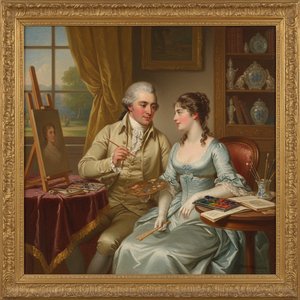
Early Life and Apprenticeship
Richard Collins, born in the naval town of Gosport, Hampshire on January 30th, 1755, emerged into a world steeped in maritime tradition yet soon found his artistic calling far removed from shipbuilding. His early life offered little indication of the refined miniature painter he would become; however, it was through an apprenticeship with Jeremias Meyer that Collins’s path truly began to unfold. Meyer, a respected enamel artist, provided Collins with foundational training in this delicate and demanding art form – a skill highly prized during the Georgian era for its ability to capture likenesses with exquisite detail and luminosity. This early exposure to enamel painting would profoundly shape Collins's style and ultimately lead to his appointment as principal painter in enamel to King George III. The meticulous nature of enamel work instilled in him a patience and precision that became hallmarks of his mature portraits, allowing him to render not just features but also the very essence of his sitters.Ascent to Royal Favor and Artistic Practice
Collins’s talent quickly garnered recognition, evidenced by his early exhibitions at the Royal Academy in 1777. He rapidly established himself as a sought-after portraitist, sharing patronage with prominent artists like Richard Cosway and Samuel Shelley. The fashionable elite of the day clamored for his services, drawn to his ability to create intimate, captivating miniatures that reflected their status and taste. His portraits weren’t merely representations; they were carefully constructed statements of identity. In 1789, a pivotal moment arrived with his appointment as principal painter in enamel to King George III. This prestigious position cemented Collins's reputation and brought him into the heart of royal circles. He was commissioned to paint numerous members of the royal family and aristocracy, creating a lasting record of Georgian society’s most influential figures. His technique involved layering translucent enamels onto metal supports – often copper or gold – building up depth and color with astonishing subtlety.Style and Influences
Richard Collins's style is characterized by its elegance, refinement, and attention to detail. While influenced by earlier miniature painters such as Rosalba Carriera, he developed a distinctive approach that blended meticulous realism with a delicate sense of romanticism. His portraits often feature sitters posed against simple backgrounds, allowing their features and attire to take center stage. He possessed an exceptional ability to capture the textures of fabrics – silks, velvets, and lace – and the subtle nuances of skin tones. His work reflects the prevailing aesthetic sensibilities of the late Georgian period, emphasizing grace, poise, and social standing. The influence of Cosway is visible in his skillful rendering of facial expressions and the overall air of sophistication that permeates his miniatures. However, Collins distinguished himself through his mastery of enamel painting, achieving a unique luminosity and depth of color that set his work apart.Legacy and Historical Significance
Richard Collins died in London on November 28th, 1831, leaving behind a substantial body of work that provides invaluable insights into the lives and personalities of Georgian Britain’s elite. His miniatures are now highly sought after by collectors and museums worldwide, prized for their artistic merit and historical significance. He stands as one of the most accomplished miniature painters of his era, renowned for his technical skill, elegant style, and ability to capture the essence of his sitters. Beyond his individual achievements, Collins’s work reflects a broader cultural shift towards portraiture as a means of self-representation and social advancement. His portraits offer a glimpse into the values, tastes, and aspirations of Georgian society, making him an important figure in the history of British art.- His miniatures provide valuable documentation of royal and aristocratic life.
- He helped elevate miniature painting to a respected art form.
- Collins’s work continues to inspire artists and collectors today.