A Life Sculpted by Myth and Modernity
Reuben Nakian, born in College Point, New York, in 1897 to Armenian immigrant parents, emerged as a pivotal figure in 20th-century American sculpture. His journey was one of constant evolution, beginning with traditional portraiture and culminating in a unique synthesis of classical mythology and the burgeoning spirit of Abstract Expressionism. The story of his life is inextricably linked to the artistic currents of his time, shaped by both the heritage of his ancestors and the vibrant energy of New York City’s art scene. Nakian's parents, having arrived in America around 1880, instilled a sense of cultural identity that would subtly inform his later work, even as he ventured into increasingly abstract forms. His formal artistic training commenced in 1915 at the Independent School of Art—formerly known as the Robert Henri School—where he studied under Homer Boss and A.S. Baylinson, laying the foundation for a career dedicated to three-dimensional form. He further honed his skills at the Art Students League of New York before undertaking an apprenticeship with Paul Manship, a sculptor renowned for his classical style infused with Art Deco sensibilities. This early exposure to both traditional techniques and modern aesthetics proved crucial in shaping Nakian’s artistic trajectory.
The Crucible of Influence: From Portraiture to Abstraction
Nakian's initial focus lay in sculpting heads and portraits, a practice that demonstrated his technical proficiency but did not yet reveal the full scope of his creative vision. A turning point arrived with a Guggenheim Fellowship in 1930, which enabled him to travel extensively through France and Italy. This immersion in European art and culture broadened his horizons, but it was upon his return to New York that he encountered the forces that would truly revolutionize his approach. The 1930s marked the beginning of significant artistic relationships—friendships with painters like Arshile Gorky and Willem de Kooning, and later, a close bond with poet Frank O'Hara. These connections were not merely social; they represented an intellectual and aesthetic exchange that profoundly impacted Nakian’s work. Gorky, in particular, encouraged him to re-evaluate his earlier style, prompting a shift towards greater expressiveness and abstraction. This transition coincided with the rise of Abstract Expressionism, and while Nakian never fully embraced the movement's tenets, its influence is undeniable in his subsequent explorations of form and emotion. He began to move away from representational portraiture, instead delving into themes drawn from mythology, history, and the realm of pure abstraction—a bold departure that would define his mature style.
Mythological Visions: A Sculptural Language
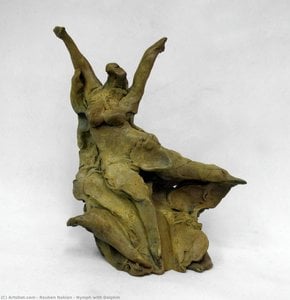
Reuben Nakian became celebrated for his sculptures inspired by the rich tapestry of Greek and Roman mythology. He didn’t simply *illustrate* these myths; he reinterpreted them through a distinctly modern lens, imbuing them with a sensual energy and psychological depth that resonated with contemporary audiences. Recurring motifs such as “Europa and the Bull,” “Leda and the Swan,” and depictions of figures like Hecuba became hallmarks of his oeuvre. Nymph and Satyr, housed at the Whitney Museum of American Art, exemplifies this approach—a work characterized by its uninhibited sensuality and dynamic composition. Leda and the Swan, residing in the Los Angeles County Museum of Art, is considered one of his most important pieces, capturing a moment of both vulnerability and power. Other notable sculptures include The Rape of Lucrece at the Decordova Museum and Sculpture Park, and The Birth of Venus, part of the collection at the Smithsonian American Art Museum. These works are not merely representations of mythological narratives; they are explorations of universal themes—desire, power, transformation, and the complex relationship between humanity and the divine. Nakian’s ability to breathe new life into these ancient stories cemented his reputation as a master storyteller in three dimensions.
Recognition and Enduring Legacy
Throughout his career, Nakian garnered significant critical acclaim and numerous accolades. Frank O'Hara’s curation of a retrospective exhibition of his sculptures at the Museum of Modern Art in New York City in 1966 stands as a testament to his artistic importance. He received honorary doctorates from the Universities of Nebraska and Bridgeport, medals from the Philadelphia College of Art and the American Academy/National Institute of Arts and Letters, and the prestigious Skowhegan Medal for Sculpture. His sculptures are now prominently featured in major museum collections across the United States—the Whitney Museum of American Art, the Smithsonian American Art Museum, the Los Angeles County Museum of Art, and the Decordova Museum and Sculpture Park among them. Nakian’s willingness to experiment with diverse materials – marble, clay, plaster, metal, paper, and even styrofoam in his later years – further underscores his innovative spirit. He remained creatively active until his death on December 4, 1986, in Stamford, Connecticut, at the age of 89. Today, Reuben Nakian is recognized as a major figure in 20th-century American sculpture—an artist who bridged the gap between classical tradition and modern abstraction, leaving an indelible mark on the art world and continuing to inspire generations of artists and scholars with his sensual, evocative, and profoundly human works. His legacy endures not only through his sculptures but also as a reminder of the power of mythology to illuminate the complexities of the human condition.