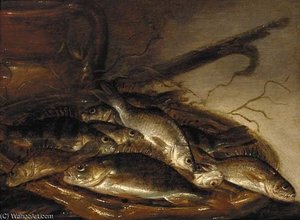
Pieter de Putter: A Master of Dutch Still Life
Pieter de Putter (c. 1600 – 1659), born in Utrecht, Netherlands, stands as a significant figure within the Dutch Golden Age artistic landscape—a period characterized by unparalleled prosperity and cultural innovation. While biographical details remain somewhat sparse compared to contemporaries like Rembrandt or Vermeer, his contribution to Flemish art is undeniable, particularly through his masterful depictions of everyday life and marine scenes. De Putter’s oeuvre reflects the humanist spirit of the era, prioritizing observation and meticulous detail to convey not merely what was seen but also how it felt.
- Early Life & Training: Precise information regarding de Putter's formative years is elusive. He apprenticed under Hendrick Jacobsz van Balen I, a prominent Utrecht painter known for his dramatic landscapes and portraits—a connection that undoubtedly instilled in him an appreciation for expressive brushwork and compositional dynamism.
- Style & Technique: De Putter’s artistic style is firmly rooted in the Flemish tradition but infused with distinctly Dutch sensibilities. He excelled at capturing the subtle nuances of light and shadow, achieving remarkable realism in his still lifes—a hallmark of the Golden Age. His canvases are characterized by careful layering of glazes, creating luminous surfaces that convey a palpable sense of atmosphere.
- Notable Works: Among his most celebrated paintings is “Pike, Rudd And Perch With Fishing-nets And A Basket On A Wooden Ledge,” showcasing an astonishing level of detail in the rendering of fish and nets—a testament to his technical prowess. Similarly impressive is "A Fisherman In His Barn With Fresh-Water Fish, A Woman In The Background," which captures a scene of rural life with remarkable sensitivity and accuracy. “Still Life with Fish, Pieter de Putter, c. 1630 - c. 1659” exemplifies his signature style—a serene composition bathed in diffused light.
- Influences: De Putter’s artistic vision was undoubtedly shaped by the prevailing trends of his time. Like many artists of the Golden Age, he drew inspiration from classical ideals and humanist scholarship, reflecting a broader intellectual climate focused on empirical observation and rational inquiry.
The Significance of Marine Art in De Putter’s Career
De Putter's fascination with the sea extended beyond mere scenic representation; it served as a conduit for exploring themes of abundance, mortality, and divine providence—concepts central to Protestant theology during the period. His marine paintings aren’t simply picturesque landscapes but carefully constructed narratives designed to convey moral lessons. The meticulous depiction of fish, nets, and boats reflects not only artistic skill but also a deeper engagement with the spiritual concerns of his era.
- His works frequently depict fishermen hauling in their catch—a symbol of earthly toil rewarded by divine grace.
- The use of chiaroscuro—the dramatic interplay of light and dark—creates a sense of solemn grandeur, emphasizing the insignificance of human endeavor against the backdrop of God’s majesty.
Legacy & Historical Context
Pieter de Putter's contribution to Dutch art is recognized as part of the broader artistic movement that flourished during the Golden Age. He stands alongside Rembrandt and Vermeer as one of the foremost painters of his generation, embodying the ideals of realism, observation, and humanist reflection—values that continue to resonate with audiences today. His paintings serve as invaluable windows into the cultural milieu of seventeenth-century Holland, offering insights into both artistic innovation and religious conviction.