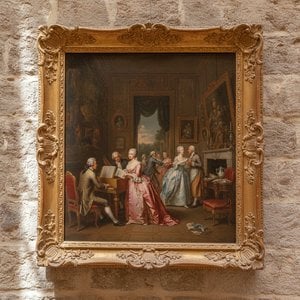
The Visionary Brush of Philip Hermogenes Calderon
Born in the historic French city of Poitiers in 1833, Philip Hermogenes Calderon carried within him a rich tapestry of European heritage that would profoundly shape his artistic voice. The son of a Spanish professor of literature and a French mother, his early life was an intersection of diverse cultural currents. While he initially harbored ambitions toward the precise world of engineering—a passion reflected in his early fascination with technical diagrams—the magnetic pull of fine art proved irresistible. This transition from the structured logic of geometry to the emotive depths of painting allowed him to bring a unique, almost architectural precision to his later compositions, blending meticulous detail with profound narrative weight.
Calderon’s artistic education was as much a journey through the heart of Europe as it was a pursuit of technical mastery. After honing his foundational skills at Leigh’s Art School in London, he ventured to Paris, immersing himself in the vibrant atmosphere of French ateliers. Studying under François-Édouard Picot, he absorbed the rigorous academic traditions of the French school, which emphasized anatomical accuracy and classical composition. This period was transformative, as it provided him with the tools to navigate the shifting tides of the nineteenth-century art world, moving seamlessly between the burgeoning Pre-Raphaelite movement and the grander traditions of historical genre painting.
From Pre-Raphaelite Precision to Historical Grandeur
The early years of Calderon’s career were marked by a deep engagement with the Pre-Raphaelite aesthetic. Influenced by the likes of Dante Gabriel Rossetti and William Holman Hunt, his early works, such as “Thy Will Be Done” (1852) and “Broken Vows” (1856), displayed a commitment to uncompromising realism and a vibrant, jewel-like palette. During this era, he was part of the celebrated St John’s Wood Clique, a group of artists who sought to infuse contemporary life with a sense of moral and aesthetic intensity. His canvases from this period are characterized by an almost breathless attention to detail, where every texture and light reflection serves to heighten the emotional stakes of the scene.
As his career matured, Calderon underwent a significant stylistic evolution, transitioning away from the tight, meticulous focus of the Pre-Raphaelites toward a more expansive and lyrical approach to historical subjects. Drawing inspiration from masters such as Edward Poynter and Frederic Leighton, he began to favor grander narratives and more atmospheric landscapes. His later works often featured women in serene, classically inspired settings, bathed in a soft, ethereal light that suggested a sense of timelessness. This shift allowed him to explore themes from literature and the Bible, transforming historical moments into poetic meditations on human emotion and grace.
A Legacy within the Royal Academy
Calderon’s influence extended far beyond the edges of his canvases; he was a central figure in the institutional life of British art. His ascent within the Royal Academy was both prestigious and profound, culminating in his appointment as Keeper of the Royal Academy. In this capacity, he acted as a guardian of artistic standards and a mentor to subsequent generations, ensuring that the traditions of fine art remained vibrant amidst the rapid changes of the Victorian era. His role as an educator and administrator cemented his status as a cornerstone of the nineteenth-century London art scene.
The historical significance of Philip Hermogenes Calderon lies in his ability to bridge disparate artistic movements. He successfully synthesized the intense, observational realism of his youth with the romanticized, classical elegance of his maturity. His life and work stand as a testament to the complexity of the Victorian era—a period caught between the rigorous scrutiny of science and the enduring allure of myth and history. Through his brush, the past was not merely recorded but reimagined, leaving behind a legacy of paintings that continue to captivate with their narrative depth and luminous beauty.
الأسئلة والأجوبة
في أي مدينة ودولة وُلد Philip Hermogenes Calderon؟
وُلد Philip Hermogenes Calderon في Poitiers، في France.
أين يمكنني استعراض جميع أعمال Philip Hermogenes Calderon الفنية؟
يمكن تصفح جميع أعمال Philip Hermogenes Calderon على هذا الموقع عبر صفحة كافة الأعمال الفنية الخاصة بالفنان.
هل يمكنني فرز أعمال Philip Hermogenes Calderon الفنية حسب اللون؟
تُتيح تدرج الألوان الخاصة بـ Philip Hermogenes Calderon تصفح أعمال الفنان مُنظمةً حسب ألوانها.