The Florentine Legacy of Niccolò Betti
In the vibrant tapestry of late Renaissance and Mannerist Italy, few names evoke the quiet transition from the grandeur of the sixteenth century to the spiritual clarity of the Counter-Reformation quite like Niccolò Betti. Born around 1550, Betti emerged from a period of profound artistic transformation. While some historical accounts link his early spirit to the devotional traditions of Bologna, much of his definitive professional identity was forged in the prestigious workshops of Florence. His journey was one of disciplined mastery, shaped by the rigorous training he received under the esteemed Michele Tosini. This apprenticeship did more than teach him the mechanics of pigment and panel; it placed him within the elite circle of artists summoned to decorate the legendary Studiolo of Francesco I in Palazzo Vecchio, a setting that demanded nothing less than absolute technical excellence.
As Betti’s career matured, he navigated the complex stylistic shifts of his era with remarkable grace. During the 1570s, his work began to reflect the influence of contemporaries such as Girolamo Macchietti and Francesco Brina, blending a certain late-Mannerist elegance with an increasing focus on clarity. His membership in the Accademia delle Arti del Disegno, which he maintained from 1576 until 1616, serves as a testament to his standing among the Florentine masters. Betti possessed a unique ability to marry the intricate, sometimes artificial poses of Mannerism with the burgeoning demand for Counter-Reformation legibility—a style that sought to move the viewer through emotional resonance and narrative directness rather than mere decorative complexity.
Mastery of Narrative and Form
The breadth of Betti’s oeuvre reveals an artist capable of traversing both the intimate and the monumental. His paintings often serve as windows into historical and sacred dramas, executed with a command of light and color that breathes life into every figure. One of his most striking achievements is the 1572 work, The Sack of Corinth. In this oil on panel, Betti captures a moment of intense historical upheaval, utilizing the medium to create vivid colors and intricate details that heighten the sense of movement and energy. The presence of subtle naturalistic elements, such as the inclusion of dogs within the scene, adds a layer of grounded realism to an otherwise epic composition, showcasing his ability to balance drama with observational truth.
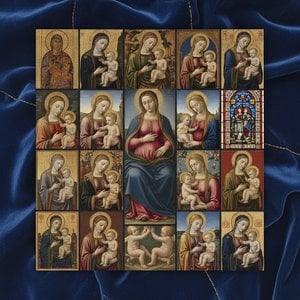
Beyond historical narratives, Betti’s devotion to religious iconography remains a cornerstone of his legacy. His sacred works, including various depictions of the Annunciation and the tender Virgin and Child with the Infant St John the Baptist, demonstrate a profound spiritual sensitivity. In these pieces, he moved away from excessive ornamentation to embrace a more restrained aesthetic. By focusing on luminous surfaces and subtle tonal gradations, Betti ensured that the divine subjects remained the focal point, inviting the faithful into a state of quiet contemplation. His ability to imbue even the most traditional compositions with a palpable sense of emotion allowed his work to resonate deeply within the churches and monasteries of the Tuscan countryside.
A Lasting Impression on the Italian Renaissance
As the sixteenth century drew to a close, Betti’s influence extended far beyond the borders of Florence. His reputation for quality led to significant commissions that connected him to the highest echelons of power, most notably the Medici family. These prestigious assignments, such as the creation of canvases for the Spanish monastery of Las Descalzas Reales in Valladolid around 1610, illustrate how his artistic language traveled across Europe, carrying the refined sensibilities of the Italian Renaissance to international audiences. Even as his activity appeared to wane with the dawn of the seventeenth century, the foundation he laid through his disciplined technique and emotive power remained unshakable.
Ultimately, the significance of Niccolò Betti lies in his role as a bridge between eras. He was an artist who could inhabit the sophisticated, stylized world of the Mannerists while simultaneously preparing the way for the more direct, emotionally charged art of the following century. Through his meticulous handling of oil and panel, and his dedication to both historical truth and religious devotion, Betti left behind a body of work that continues to captivate those seeking to understand the soul of the late Italian Renaissance. His life remains a testament to the enduring power of craftsmanship and the profound impact of an artist dedicated to the service of both beauty and belief.