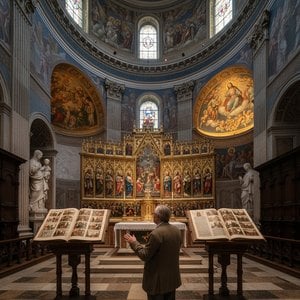
The Enamelled Light of Limoges: Master Alpais and the Art of Reliquaries
The name “Master Alpais” conjures a world steeped in gold, vibrant color, and profound religious devotion—a world centered in the medieval city of Limoges, France. Though shrouded in the mists of time, this 12th-century artist stands as one of the most significant figures in the development of Limoges enamelwork, a technique that transformed small devotional objects into breathtaking works of art. Unlike many artists of his era whose names remain lost to history, Master Alpais is known through the inscription he boldly placed upon some of his creations: “Master G. Alpais made me in Limoges.” This simple declaration not only identifies him but also anchors his work firmly within a specific place and tradition.
Active between approximately 1180 and 1200, Master Alpais flourished during a period of burgeoning artistic innovation across Europe. Limoges had already established itself as a center for metalworking, particularly in bronze, but the introduction of enamel painting techniques—likely influenced by Byzantine traditions—revolutionized its output. Enamelling involved fusing glass paste onto metal surfaces, allowing for incredibly detailed and luminous imagery. This was not merely decoration; it was a means of elevating sacred objects to new heights of beauty and reverence. The precise details of Alpais’s life remain elusive. He wasn't part of the courtly circles that often patronized artists, but rather served the needs of the Church and individual devotees seeking exquisite reliquaries and liturgical vessels.
A Master of Ciborium and Reliquary Forms
Master Alpais’s surviving works primarily consist of ciboria—vessels used to hold the consecrated host during the Eucharist—and reliquaries, containers designed to house sacred relics. These objects were not simply functional; they were intended as visual expressions of faith and testaments to the power of the saints whose remains they protected. His ciborium in the Louvre is arguably his most celebrated piece. The intricate scenes depicted on its surface showcase a remarkable mastery of enamel painting. The figures are rendered with delicate precision, their faces imbued with an expressive quality that belies the small scale of the work. Gold backgrounds and carefully chosen colors create a sense of otherworldly radiance, drawing the viewer into the sacred narrative.
Beyond the ciborium, his Reliquary of Thomas Becket is another exceptional example of his skill. The reliquary’s form itself—often shaped like miniature shrines or architectural structures—was integral to its meaning. Alpais's work demonstrates a sophisticated understanding of composition and narrative storytelling. He wasn’t merely replicating existing images; he was creating new visual interpretations that resonated with the spiritual beliefs of his time. The use of cloisonné enamel, where thin metal strips separate areas of different colored enamel, is particularly prominent in his work, allowing for a remarkable level of detail and precision.
Influences and Artistic Development
Pinpointing the specific influences on Master Alpais’s style is a complex undertaking. The artistic landscape of 12th-century France was diverse, drawing inspiration from Romanesque sculpture, Byzantine mosaics, and illuminated manuscripts. The influence of Byzantine art is particularly evident in his use of gold backgrounds and stylized figures. However, Alpais wasn’t simply copying existing styles; he synthesized these influences into a uniquely Limoges aesthetic characterized by its delicate detail, vibrant color palette, and emphasis on narrative clarity.
His development as an artist likely involved a period of apprenticeship within one of the established workshops in Limoges. The collaborative nature of medieval art production meant that artists often worked alongside other craftsmen—metalworkers, jewelers, and glassmakers—sharing skills and techniques. The quality and consistency of his work suggest a high level of training and expertise. It is also plausible that he benefited from exposure to imported enamelwork, which would have provided him with new models and inspiration.
Historical Significance and Legacy
Master Alpais’s significance extends beyond the exceptional beauty of his individual creations. He represents a pivotal moment in the history of Limoges enamelwork, helping to establish the city as a leading center for this art form. His work influenced generations of subsequent artists, who continued to refine and develop the techniques he pioneered. The ciboria and reliquaries produced in Limoges during the 12th and 13th centuries became highly sought-after objects throughout Europe, adorning churches and private collections alike.
The enduring appeal of Master Alpais’s work lies not only in its technical brilliance but also in its ability to convey a sense of profound spiritual devotion. These objects were created for a world where faith permeated every aspect of life, and they serve as powerful reminders of the artistic skill and religious fervor of the medieval period. His signature—a simple declaration of authorship—has ensured that his name continues to resonate through the centuries, a testament to the enduring power of art to transcend time and connect us with the past.
الأسئلة والأجوبة
هل يوجد تسلسل زمني لمسيرة Master Alpais؟
تُعد مسيرة فنية الخاصة بـ Master Alpais خطاً زمنياً تفاعلياً يعرض أعمال الفنان بترتيب زمني، مقسمة إلى فصول تمثل مراحل مسيرته المهنية.
أين يمكنني استعراض جميع أعمال Master Alpais الفنية؟
يمكن تصفح جميع أعمال Master Alpais على هذا الموقع عبر صفحة كافة الأعمال الفنية الخاصة بالفنان.
هل يمكنني زيارة متحف افتراضي لأعمال Master Alpais؟
تُعد متحف ثلاثي الأبعاد الخاصة بـ Master Alpais صفحة تعرض أعمال الفنان في معرض افتراضي ثلاثي الأبعاد.