The Lens of Memory: The Artistic Journey of Martin Kollár
In the quiet, evocative landscapes of the Slovakian countryside, there exists a profound dialogue between the physical earth and the intangible layers of human history. This is the realm inhabited by Martin Kollár, a photographer and cinematographer whose work serves as a bridge between the visible world and the echoes of what has passed. Born in Žilina in 1971, Kollár’s artistic sensibility was forged at the intersection of visual storytelling and cinematic depth. His early training at the Academy of Performing Arts in Bratislava provided him with more than just technical proficiency; it gifted him a director's eye, allowing him to approach the still frame with an understanding of movement, light, and the dramatic tension inherent in every composition.
Kollár’s transition from the moving image to photography was not a departure but an evolution. While cinematography taught him how to guide a narrative through time, photography allowed him to freeze it, capturing the precise moment where a landscape begins to whisper its secrets. His work is deeply rooted in the concept of place—not merely as a geographical location, but as a vessel for memory and identity. Through his lens, the Slovakian vistas are transformed into contemplative spaces where the viewer is invited to search for the traces of past lives and the subtle textures of existence that often go unnoticed in the rush of modernity.
A Mastery of Atmosphere and Form
The aesthetic language of Kollár is one of restrained elegance and meticulous precision. He possesses a rare ability to utilize color palettes that do more than just depict reality; they evoke a specific emotional temperature, ranging from the melancholic stillness of a misty morning to the stark, haunting clarity of an abandoned structure. His preference for large-format prints underscores this commitment to detail, as each image becomes an expansive window into a world where subtle nuances—the grain of wood, the way light hits a weathered stone, or the distant silhouette of a mountain—are given monumental importance.
Technically, Kollár employs a sophisticated approach to light and time. By utilizing slow shutter speeds and careful exposure adjustments, he achieves a sense of stasis that is both tranquil and unsettling. This technique allows him to soften the edges of reality, creating images that feel less like snapshots and more like dreamscapes or historical artifacts. His work often avoids the pursuit of the overtly spectacular, choosing instead to find the extraordinary within the ordinary. He seeks out the oddities of everyday life, the incongruous moments, and the quiet tensions that exist in the periphery of our vision, turning the mundane into something deeply poetic.
Global Recognition and Conceptual Depth
Kollár’s career is marked by significant milestones that have brought his unique Slovakian perspective to the international stage. His ability to weave conceptual depth into documentary-style photography earned him the prestigious Leica Oskar Barnack Award in 2014, a testament to his mastery of the medium. Beyond the borders of Slovakia, his work has been exhibited in some of the world's most esteemed institutions, including the Maison européenne de la photographie in Paris, the Slovak National Gallery in Bratislava, and the Musée de l'Élysée in Lausanne.
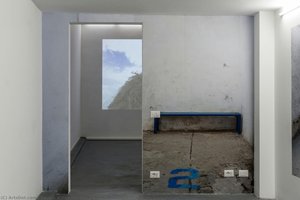
One of his most profound contributions to contemporary art lies in his site-specific installations, such as the ambitious Prisons from Ukraine project. In these works, Kollár moves beyond the single frame to create immersive environments that confront the viewer with the weight of political and human reality. His ability to blend the observational rigor of a documentary photographer with the conceptual complexity of an installation artist allows him to tackle heavy themes—such as confinement, memory, and the scars of conflict—with a sensitivity that is both haunting and deeply humanistic. Through his enduring practice, Martin Kollár continues to document not just what we see, but what we feel when we look closely at the world around us.