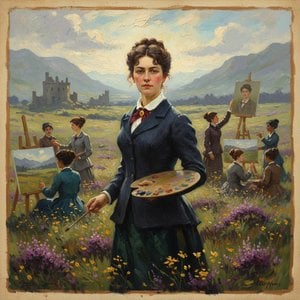
A Life Intertwined with Art: The World of Mabel Pryde
Mabel Scott Lauder Pryde (1871-1918) occupies a fascinating, and historically undervalued, position within the landscape of early 20th-century British art. Often remembered as the wife of artist William Nicholson and the mother of celebrated figures like Ben and Nancy Nicholson, Mabel was, in her own right, a sensitive and insightful painter whose work offers a poignant glimpse into domestic life and familial bonds during a period of significant artistic change. Born in Edinburgh to David Pryde, headmaster of Edinburgh Ladies College, and Barbara Lauder – a family with deep roots in the Scottish art world through connections to Robert Scott Lauder and James Eckford Lauder – Mabel’s upbringing immersed her in a creative atmosphere that would profoundly shape her path. The presence of her brother, James Pryde, also pursuing an artistic career, further solidified this familial dedication to visual expression.Formative Years and Artistic Development
Mabel's formal artistic training began at the Bushey School of Art under the tutelage of Hubert von Herkomer. This period proved pivotal, not only for honing her technical skills but also for a life-altering encounter: she met William Nicholson, whom she would marry in 1893. Their marriage marked the beginning of a vibrant artistic partnership and a home that quickly became a haven for creative exchange. Initially settling at Eight Bells in Denham, Buckinghamshire, alongside Mabel’s brother James, the couple later moved to Rottingdean in 1909, immersing themselves within the thriving artist colony there. This relocation brought them into contact with a diverse group of artists and intellectuals, further enriching their artistic perspectives. The family dynamic itself became central to Mabel's work; she frequently depicted her four children – Ben, Anthony, Nancy, and Christopher “Kit” – in candid and affectionate poses, capturing the essence of childhood and the intimacy of family life.A Palette of Domesticity: Themes and Style
Mabel Pryde’s artistic output is characterized by its intimate portrayal of domestic scenes and sensitive portraits. Her paintings are not grand historical narratives or bold explorations of abstract form; instead, they reside in the quiet moments of everyday life – a child lost in thought, a family gathered together, the subtle play of light within a room. This focus on the personal and the immediate reveals a keen observational skill and an ability to convey emotional depth with remarkable subtlety. Her style often features a muted palette, emphasizing soft tones and gentle gradations of color, creating a sense of quiet contemplation. There’s also a noticeable emphasis on texture, achieved through delicate brushwork and impasto techniques, adding another layer of richness and complexity to her compositions. While not strictly adhering to any single artistic movement, Pryde's work demonstrates an awareness of Impressionistic principles in its handling of light and color, suggesting a broader engagement with the evolving aesthetic landscape of the time.Legacy and Rediscovery
For many years, Mabel Pryde’s contributions were overshadowed by the achievements of her husband and children. William Nicholson enjoyed considerable success during his lifetime, and Ben Nicholson would later become a leading figure in British abstract art. However, recent scholarship and exhibitions have begun to redress this historical imbalance, recognizing Mabel's work for its intrinsic merit and unique perspective. Her paintings offer valuable insights into the domestic life of artists in early 20th-century Britain, providing a nuanced portrayal of family relationships and the challenges faced by women pursuing artistic careers during that era. Her influence can be seen indirectly through the artistic paths taken by her children, particularly Ben Nicholson, who acknowledged his mother’s encouragement and support throughout his career. Tragically, Mabel Pryde died in July 1918, a victim of the Spanish flu pandemic, cutting short a promising artistic journey. Despite the brevity of her career, her legacy endures as a testament to her talent, sensitivity, and enduring contribution to British art. Her work continues to resonate with viewers today, offering a poignant reminder of the beauty and complexity of everyday life.الأسئلة والأجوبة
كيف يمكنني العثور على جميع أعمال Mabel Pryde حسب الوسيط الفني؟
يمكن تصفح أعمال Mabel Pryde حسب الوسيط الفني عبر صفحة حسب الوسيط الفني.
ما هي الأسماء المستعارة أو الأسماء الأخرى التي يُعرف بها Mabel Pryde؟
يُعرف Mabel Pryde أيضاً بأسماء أخرى هي Mrs. Nicholson Pryde, Mabel Nicholson, Mabel Pryde Nicholson, Mabel Scott Lauder Pryde, メーベル・プライド.
أين ومتى وُلد Mabel Pryde؟
وُلد Mabel Pryde في Edinburgh عام 1871.