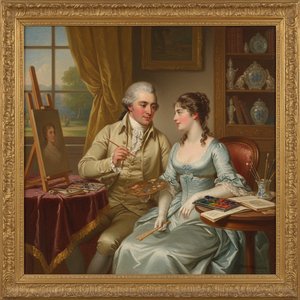
A Gentle Hand at the Tudor Court: The Life and Legacy of Levina Teerlinc
The name Levina Teerlinc may not resonate as immediately as Holbein or Hilliard, yet within the intricate world of sixteenth-century portraiture, she occupied a position of remarkable significance. As court miniaturist to Henry VIII, Edward VI, Mary I, and Elizabeth I, Teerlinc was the foremost artist in her field during a period of immense political and religious upheaval in England. Her delicate brushstrokes captured not just likenesses, but also the evolving image of power itself, making her a pivotal figure in the development of the English portrait miniature. Born in Bruges around 1510 into a family steeped in artistic tradition—her father, Simon Bening, was a celebrated book illuminator and miniaturist of the Ghent-Bruges school—Levina’s early life undoubtedly shaped her exceptional talent. The meticulous detail and refined aesthetic characteristic of Flemish manuscript painting would become hallmarks of her own work, though sadly few examples are definitively attributed to her today. It is believed she received training within her father's workshop before her marriage in 1545 to George Teerlinc of Blanckenberge, a connection that likely facilitated her move to England shortly thereafter.
The Tudor Palette: Service and Status
Levina’s arrival at the English court in 1546 marked the beginning of a long and prosperous career. Appointed as painter to Henry VIII, she quickly established herself as a favored artist, receiving an annual salary of £40—a sum that notably exceeded even Holbein's remuneration. This financial stability speaks volumes about the value placed on her skills and the consistent demand for her portraits. Serving four successive monarchs presented unique challenges; each ruler possessed distinct tastes and desired to project a specific image. Teerlinc’s ability to adapt while maintaining her signature style was crucial to her continued success. While no works are definitively known from her time under Henry VIII, it is reasonable to assume she contributed to the visual propaganda of his reign, crafting images that reinforced his authority and dynastic ambitions. The transition to Edward VI brought a shift in focus towards portraits reflecting the young king’s Protestant faith. Under Mary I, Teerlinc continued to produce miniatures, including a charming “small picture of the ‘trynitie’” gifted as a New Year present in 1556. However, it was her service to Elizabeth I that cemented her legacy.
Elizabethan Likenesses: Crafting an Icon
The reign of Elizabeth I proved to be Teerlinc’s most prolific period, though frustratingly, concrete attribution remains elusive. Records indicate she painted numerous portraits of the Queen throughout the 1550s and 70s—in 1559, 1562, 1563, 1564, 1567 (“a full-length portrait”), 1568 (“with knights of the order”), 1575 (“with other personages”), and again in 1576. These portraits weren’t merely representations; they were carefully constructed icons designed to project Elizabeth's power, intelligence, and virginity. The miniatures likely served as diplomatic gifts, circulated amongst potential suitors and allies, and functioned as powerful tools of statecraft. Teerlinc’s skill lay in her ability to capture the Queen’s likeness with both accuracy and flattery, employing a refined technique that emphasized delicate features, luminous skin tones, and rich jewelery.
The very lack of surviving works adds to the mystique surrounding her artistry, prompting ongoing scholarly debate about their appearance and influence.
Technique and Influence: A Legacy in Miniature
Although no paintings are definitively attributed to Teerlinc, scholars infer her methods through contemporary accounts and the work of artists who followed in her footsteps. She likely employed techniques common to Flemish miniaturists—layers of translucent glazes built up on a small ivory or vellum support, creating depth and luminosity. The use of fine brushes and meticulous detail was paramount, allowing for incredibly realistic depictions within a limited space.
Her influence is most strongly felt in the rise of the portrait miniature as a distinct art form in England. It’s widely believed that she may have trained Nicholas Hilliard, the leading miniaturist of the Elizabethan era, possibly instructing him in the techniques of preparing panels and applying paint. While direct evidence remains scarce, the stylistic similarities between their work suggest a strong connection. Furthermore, her position at court established miniature painting as a prestigious profession, attracting talented artists and patrons alike.
A Lasting Impression: Historical Significance
Levina Teerlinc died in Stepney, London, on June 23, 1576, leaving behind a legacy that continues to fascinate art historians. Despite the absence of securely attributed works, her importance as the dominant miniaturist at the Tudor court is undeniable. She navigated the complexities of royal patronage with grace and skill, crafting images that shaped perceptions of power during a transformative period in English history.
- She was the most important miniaturist between Hans Holbein the Younger and Nicholas Hilliard.
- Her father, Simon Bening, was a renowned book illuminator.
- She received an annual salary exceeding that of Holbein at the English court.
- She served four successive monarchs: Henry VIII, Edward VI, Mary I and Elizabeth I.
Her contribution to the development of the portrait miniature—a genre that would flourish in subsequent centuries—remains a testament to her artistic talent and enduring influence. The search for definitive examples of her work continues, driven by the hope of fully illuminating the artistry of this remarkable woman who held a gentle hand at the heart of the Tudor court.