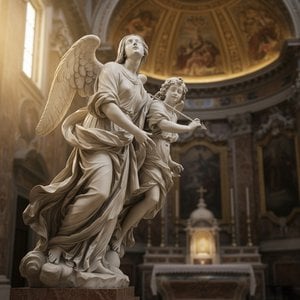
Laurent-Honoré Marqueste: A Neo-Baroque Master of Myth and Majesty
Born in Toulouse in 1848, Laurent-Honoré Marqueste emerged as a significant figure in late 19th and early 20th-century French sculpture. His artistic journey, marked by rigorous training, prestigious awards, and a profound engagement with classical ideals, culminated in a body of work that continues to captivate audiences with its dramatic intensity, technical virtuosity, and evocative storytelling. Marqueste’s legacy resides not only in his impressive public commissions but also in his ability to imbue marble and bronze with a palpable sense of movement, emotion, and timeless grandeur.
Marqueste's artistic foundation was meticulously laid under the tutelage of two prominent sculptors: François Jouffroy, a leading figure in the Realist movement, and Alexandre Falguière, renowned for his dynamic and emotionally charged works. These influential mentors instilled within him a deep appreciation for anatomical accuracy, expressive gesture, and the power of narrative sculpture. Crucially, he was awarded the Prix de Rome in 1871 – a highly competitive scholarship that afforded him invaluable study time at the Villa Medici in Rome. This period proved transformative, allowing Marqueste to immerse himself in the artistic heritage of antiquity, particularly the works of Greek and Roman sculptors, which profoundly shaped his aesthetic sensibilities.
The Beaux-Arts Style and Marqueste’s Artistic Evolution
Marqueste firmly established himself within the Neo-Baroque Beaux-Arts tradition, a style characterized by its monumental scale, dramatic compositions, and revival of classical forms. This movement sought to synthesize the grandeur of the Baroque with the principles of academic art, emphasizing technical skill, historical subject matter, and idealized beauty. Marqueste’s sculptures frequently drew inspiration from mythology – tales of heroic struggles, divine interventions, and fantastical creatures – offering viewers a visual feast of dramatic narratives. His works are notable for their dynamic poses, carefully rendered musculature, and the interplay of light and shadow, creating an illusion of life and movement.
His early career was marked by consistent success at the Paris Salon, where he showcased his talent and garnered critical acclaim. Notable amongst these early pieces is “Jacob and the Angel,” a plaster relief that earned him a third-class medal in 1876. This initial recognition paved the way for further accolades, including a first-class medal for "Perseus Slaying Medusa" (1879) and a second-class medal for “Velléda” (1877). These awards not only validated his artistic abilities but also established him as a rising star within the French art world. His later works, such as “Perseus and the Gorgon,” further cemented his reputation for dramatic storytelling and technical mastery.
Major Works and Public Commissions
Marqueste’s career was punctuated by numerous significant commissions that left an enduring mark on the Parisian landscape. His monumental sculpture of "Perseus and the Gorgon," now housed in the Musée des Beaux-Arts de Lyon, exemplifies his ability to capture a pivotal moment from mythology with breathtaking detail and dramatic intensity. The work's dynamic composition, intricate marble carving, and evocative portrayal of the hero’s triumph over the monstrous Gorgon are testament to Marqueste’s technical skill and artistic vision.
Beyond “Perseus and the Gorgon,” Marqueste contributed significantly to the embellishment of several iconic Parisian landmarks. He sculpted allegorical figures for the façade of the Musée d'Orsay, created portraits of prominent historical figures (including Victor Hugo), and designed monumental sculptures for the Grand Palais, a key feature of the 1900 Exposition Universelle. His work on the Hôtel Dufayel, though ultimately demolished, showcased his ability to integrate sculptural elements seamlessly into architectural designs. His contributions extended beyond Paris, including works in North and South America, reflecting his growing international recognition.
Legacy and Influence
Laurent-Honoré Marqueste’s influence extends far beyond the immediate impact of his individual sculptures. He served as a professor at the École des Beaux-Arts de Paris for many years, shaping the artistic development of generations of young sculptors. His students included Fanny Rozet, who went on to become a respected artist in her own right. Marqueste’s commitment to classical principles and his mastery of Neo-Baroque techniques ensured that he remained a vital force within the French art world until his death in 1920. Today, his works are treasured for their beauty, technical skill, and enduring power to evoke emotion and transport viewers to worlds of myth and legend.
His legacy is preserved through numerous museum collections across France, including the Musée d’Orsay, the Petit Palais, and regional museums, ensuring that his artistic contributions continue to be appreciated by audiences worldwide.