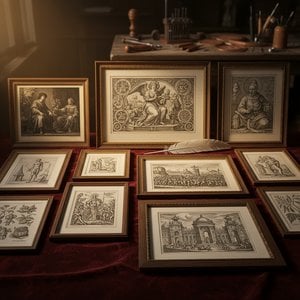
Jacques Lagniet: A Satirical Voice of 17th-Century France
Jacques Lagniet (c. 1620 – 1675) stands as a fascinating figure in the history of French printmaking, largely defined by his biting social commentary and masterful woodcuts. Born in Paris, he navigated the turbulent artistic landscape of the late 17th century, establishing himself as both a publisher and an engraver, primarily focusing on producing affordable prints that captured the everyday life and folklore of his time. Unlike many artists of his era who sought patronage from wealthy collectors, Lagniet catered to a broader market, making his work accessible to a wider audience – a strategy that allowed him to produce a remarkably prolific body of work.
Early Life and Career
Little is definitively known about Lagniet’s early life. Records are scarce, contributing to the somewhat enigmatic nature of his artistic career. However, it's believed he began his printmaking journey in Paris, likely apprenticed to a workshop producing popular prints. His skill quickly became apparent, and he soon established himself as an independent publisher and engraver, operating from his studio on the Quai de la Mégisserie. This location afforded him access to a bustling commercial center, facilitating distribution of his work.
Themes and Style: Satire and Beyond
Lagniet’s enduring legacy rests primarily on his satirical engravings. He possessed a keen eye for the foibles of society, depicting scenes of everyday life with sharp wit and often pointed criticism. His subjects ranged from biblical narratives – frequently reinterpreted with a distinctly secular perspective – to popular tales, moral lessons, and even caricatures of prominent figures. His work isn’t simply humorous; it's a subtle yet persistent critique of social norms, religious hypocrisy, and the excesses of the era. The ‘Recueil des plus illustrés proverbes divises en trois livres,’ published in the 1660s, is a testament to this – a collection of fables and proverbs rendered with his characteristic blend of realism and satire.
Technically, Lagniet was a skilled woodcutter. His prints are characterized by their detailed observation, dynamic compositions, and a remarkable ability to convey emotion through subtle gestures and expressions. He employed a relatively simple yet effective style, prioritizing clarity and accessibility over elaborate detail. His use of light and shadow created depth and realism, while his figures possessed a lively energy that brought his scenes to life.
Notable Works and Influences
Several of Lagniet’s engravings stand out as particularly noteworthy examples of his talent and satirical vision. “Don Quixote & Sancho Pansa” offers a vibrant depiction of Cervantes' iconic characters, showcasing his ability to capture the essence of literary figures within a print medium. “Satiric engraving of St. pilgrims from Jacques Lagniet from the Recueil des plus illustrés proverbes of (1657)” exemplifies his talent for blending religious themes with social critique. His work reflects influences from both Mannerism and emerging Classicism, demonstrating a sophisticated understanding of artistic tradition while forging his own distinctive style.
Legacy and Historical Significance
Jacques Lagniet’s contribution to the history of printmaking is significant not only for the volume of his output but also for his role as a voice of social commentary. He democratized access to art by producing affordable prints that resonated with a broad segment of the population. His satirical depictions provided a critical lens through which to examine the values and practices of 17th-century France. His work continues to be studied and appreciated today, offering valuable insights into the cultural dynamics of his time and demonstrating the power of printmaking as a medium for social critique. The Metropolitan Museum’s collection, including the “Recueil des plus illustrés proverbes,” provides crucial access to this important artist's oeuvre.
Further research can be found at the British Museum (link) and through online archives like Archive.org and Gallica, where digitized versions of his publications are readily available.