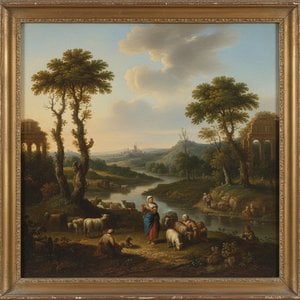
Jacob Sibrandi Mancadan: A Friesian Visionary of the Dutch Golden Age
Jacob Sibrandi Mancadan (c. 1605 – 1673) stands as a pivotal figure in Friesian art history and a respected landscape painter within the broader context of the Dutch Golden Age. Though overshadowed by contemporaries like Rembrandt and Vermeer, Mancadan’s distinctive style—characterized by an idealized yet subtly naturalistic approach—contributed significantly to the artistic landscape of his time and continues to resonate with viewers today. His canvases offer glimpses into the serene beauty of Friesland and reflect a humanist sensibility that distinguishes him from many other artists of his era.
Early Life and Education
Information about Mancadan’s formative years remains somewhat sparse, primarily gleaned from archival records documenting his involvement in municipal administration. Born around 1605, he hailed from Franeker, Groningen Province—a region renowned for its peatlands and agricultural traditions. While precise details of his formal artistic training are elusive, Mancadan's exposure to the artistic currents circulating in Haarlem—a major center for painting during the Golden Age—is undeniable. Haarlem’s painters, notably Jan van Goyen and Salomon van Ruysdael, championed a style that blended observation with imaginative embellishment, influencing Mancadan’s aesthetic sensibilities. This connection to Haarlem is further substantiated by stylistic similarities between his landscapes and those produced by prominent Haarlem artists.
Style and Technique: Bridging Idealism and Observation
Mancadan's artistic vision can be described as a harmonious blend of Italianate idealism and Friesian realism. Like Salvator Rosa—a celebrated landscape painter who advocated for direct observation of nature—Mancadan sought to capture the essence of Friesland’s topography and atmosphere. However, unlike Rosa’s dramatic compositions, Mancadan's landscapes often possess a quiet dignity and tranquility. He skillfully employed atmospheric perspective—a technique perfected by Ruysdael and others—to convey depth and luminosity, creating canvases that convincingly depict the subtleties of light and shadow. Furthermore, Mancadan meticulously rendered details of Friesian flora and fauna, demonstrating a keen awareness of his surroundings. His brushstrokes are deliberate yet fluid, conveying both precision and expressive emotion.
Career Highlights and Civic Engagement
Beyond his artistic pursuits, Mancadan held positions of considerable responsibility within Franeker’s municipal government, serving as mayor from 1634 to 1644. This involvement underscored his commitment to civic duty and reflected the intellectual climate of Friesland during the Golden Age—a period marked by burgeoning humanist thought and a fascination with scientific inquiry. Notably, Mancadan spearheaded initiatives aimed at improving peatwinning operations in the southeast of Friesland, recognizing the importance of economic prosperity alongside artistic excellence. He was instrumental in constructing the canal connecting Bakkeveen to Tjerkgaast, transforming the region’s landscape and bolstering its agricultural productivity. His dedication extended beyond administrative roles; he served as a minister's son, demonstrating a family tradition of intellectual pursuits.
Legacy and Significance
Jacob Sibrandi Mancadan’s contribution to Friesian art history is undeniable. He elevated Friesland’s artistic reputation within the Netherlands and established himself as one of the foremost landscape painters of his generation. His canvases continue to captivate audiences with their serene beauty and masterful execution, serving as enduring reminders of the Dutch Golden Age's humanist spirit. Mancadan’s landscapes are not merely depictions of scenery; they embody a profound appreciation for the natural world—a sentiment that aligns seamlessly with the broader philosophical currents shaping European culture during his lifetime. His work stands as testament to the power of observation combined with artistic imagination, securing his place among the most influential artists of Friesland and the Dutch Golden Age.