Jacob van Geel: A Flemish Landscape Painter of Quiet Brilliance
Jacob Jacobsz van Geel (c.1585–1648) remains a somewhat enigmatic figure in the annals of Dutch Golden Age art, overshadowed by contemporaries like Rembrandt and Vermeer. Yet, his landscapes—particularly those executed in Antwerp—possess a remarkable subtlety and atmospheric depth that deserves greater recognition. Born in Middelburg, Netherlands, Van Geel’s artistic journey unfolded amidst the burgeoning intellectual fervor of the era, shaping him into a painter deeply attuned to the nuances of light and color.
Early biographical details are scarce, reflecting the typical limitations of documentation during his lifetime. He apprenticed under Hendrick van Balen I, a prominent Antwerp artist known for his dramatic depictions of biblical scenes. This formative experience instilled in Van Geel a foundational understanding of Baroque painting techniques—particularly chiaroscuro—a stylistic approach characterized by stark contrasts between light and dark that would become a hallmark of his oeuvre.
- Early Influences: Hendrick van Balen I’s workshop provided Van Geel with invaluable training in composition, color palettes, and the expressive power of dramatic lighting. The Baroque aesthetic championed by Balen profoundly impacted Van Geel's artistic sensibilities.
- Antwerp Workshop & Artistic Development: Following Balen’s departure, Van Geel continued his artistic pursuits independently, establishing a workshop in Antwerp where he nurtured the talents of younger artists and honed his own skills. This period witnessed a significant expansion of his stylistic repertoire, incorporating elements of Mannerism alongside Baroque conventions.
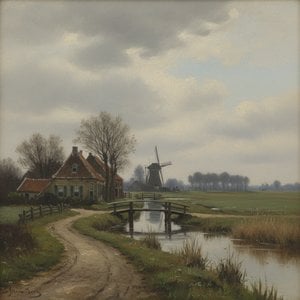
- Notable Landscapes: Van Geel’s landscapes are distinguished by their serene beauty and meticulous observation of nature. Unlike the grand vistas favored by some of his peers, he focused on capturing intimate scenes—often featuring trees, meadows, and distant hills—rendered with remarkable precision and luminous color.
- Key Paintings: Among Van Geel’s most celebrated works are “The Shepherdess” (circa 1620), housed in the Smidt Van Gelder Museum, and “Landscape with Figures” (circa 1638), residing in the Mayer van den Bergh Collection. These paintings exemplify his mastery of atmospheric perspective and his ability to convey a profound sense of tranquility.
- Legacy & Historical Significance: Although Van Geel’s fame didn't reach Rembrandt or Vermeer levels, he nonetheless contributed significantly to Antwerp’s artistic landscape during the Golden Age. His landscapes stand as testament to the quiet brilliance of Flemish painting—a subtle yet powerful reflection of the era’s aesthetic ideals and a reminder that beauty can be found in understated observation.
His paintings are admired for their delicate rendering of light and shadow, capturing fleeting moments of natural splendor with remarkable sensitivity. Van Geel's contribution to Flemish landscape painting deserves renewed appreciation as scholars continue to delve deeper into his life and artistic legacy.