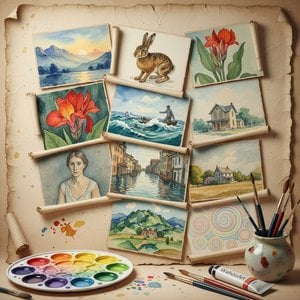
A Brush with Serenity: The World of Hu Xigui
Hu Xigui is a contemporary Chinese artist whose work resonates with a quiet power, drawing viewers into landscapes steeped in atmosphere and portraits that whisper untold stories. While biographical details remain intentionally scarce – Xigui prefers to let his paintings speak for themselves – his art has rapidly gained recognition for its masterful technique and deeply evocative emotional core. Emerging from a rich tradition of Chinese painting yet distinctly modern in sensibility, Hu Xigui’s canvases offer a compelling bridge between past and present. He is currently living and working as an artist.
The Language of Water and Ink
Xigui's artistic foundation lies firmly within the traditions of *shui-mo hua*, or water ink painting, a style that emphasizes brushwork, the subtle gradations of ink wash, and the expressive use of empty space. However, he doesn’t simply replicate tradition; he reimagines it. His landscapes aren’t depictions of specific locations so much as emotional responses to nature – feelings of solitude, peace, and the ephemeral beauty of the natural world. He often employs a muted palette, favoring soft blues, greens, and grays that create an ethereal quality. The women featured in his portraits are similarly enveloped in this atmospheric haze, their faces possessing a gentle melancholy and introspective grace.
- Watercolor Mastery: While rooted in ink traditions, Xigui frequently incorporates watercolor techniques to achieve delicate washes and nuanced color variations.
- Subtle Symbolism: Recurring motifs like bamboo, plum blossoms, and birds are not merely decorative elements but carry layers of symbolic meaning drawn from Chinese culture – resilience, perseverance, and freedom respectively.
- Emphasis on Atmosphere: Xigui’s work prioritizes the creation of mood and feeling over precise representation. His paintings invite contemplation rather than immediate interpretation.
Influences and Artistic Development
Though details about his formal training are limited, it is clear that Hu Xigui possesses a profound understanding of classical Chinese art. The influence of Song Dynasty landscape masters like Fan Kuan and Guo Xi can be seen in the monumental quality of some of his compositions, while the delicate figure painting traditions of the Ming Dynasty inform his portraits. However, Xigui’s work also reveals an awareness of Western Impressionism and Post-Impressionism, particularly in his use of light and color to create atmosphere. He doesn't imitate these styles directly but rather synthesizes them with his Chinese heritage, resulting in a unique visual language that is both familiar and strikingly original. His development appears to be one of continuous refinement – a stripping away of unnecessary detail to reveal the essential emotional core of his subjects.
Women and Nature: Recurring Themes
The two central themes in Hu Xigui’s work are women and nature, often intertwined. His female figures aren't presented as idealized beauties but rather as introspective individuals deeply connected to their surroundings. They appear lost in thought, gazing out at landscapes that mirror their inner states. The natural world itself is not merely a backdrop but an active participant in the emotional drama of his paintings.
The trees seem to share the women’s solitude, and the flowing water reflects their quiet contemplation. This interplay between figure and landscape suggests a profound sense of harmony and interconnectedness – a belief that humans are an integral part of nature, not separate from it.
A Contemporary Voice in Traditional Form
Hu Xigui's growing international acclaim is testament to the universal appeal of his art. In a world saturated with visual noise, his paintings offer a sanctuary of calm and contemplation. He represents a vital continuation of Chinese artistic traditions, demonstrating that these ancient forms can remain relevant and powerfully expressive in the 21st century. His work isn’t about grand statements or overt narratives; it's about capturing fleeting moments of beauty, evoking subtle emotions, and reminding us of the profound connection between ourselves and the natural world. He is a master of atmosphere, a poet of ink and watercolor, and a compelling voice in contemporary art.