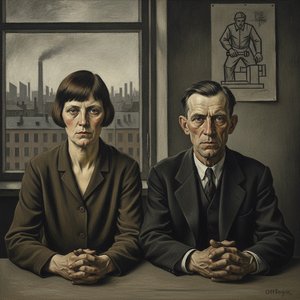
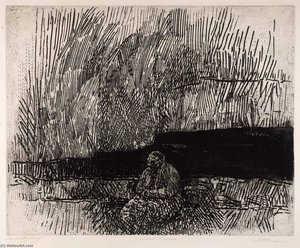
Harold Altman: A Visionary of Urban Intimacy
Harold Altman (1924-2003) wasn’t a name immediately recognized by the general public, yet within the world of printmaking and particularly New York City art, he stands as a quietly profound figure. His work, often characterized by a melancholic beauty and an astute observation of everyday life, captured a specific mood – a sense of urban solitude and understated drama – that resonated deeply with viewers long after its creation. Altman’s career spanned seven decades, marked by a dedication to his craft and a consistent exploration of themes centered around the human experience within the sprawling landscape of New York City and beyond.
Born in the Bronx, New York, Altman's artistic journey began early. He displayed an aptitude for drawing from childhood, finding solace and expression through visual representation. This nascent talent was nurtured during his time at the Art Students League, where he honed his skills and developed a distinctive style. Crucially, his education extended beyond traditional instruction; he spent formative years in Europe, particularly in Paris, immersing himself in the artistic currents of the era and absorbing the techniques of masters like Rembrandt and Dürer. This exposure profoundly shaped his approach to printmaking, influencing his meticulous attention to detail and his masterful use of line and texture.
Altman’s early work focused on capturing the essence of Central Park – a beloved refuge within the concrete jungle of New York City. These prints weren't merely depictions of scenery; they were imbued with a sense of quiet contemplation, reflecting the park’s role as a space for respite and connection. He masterfully rendered the interplay of light and shadow, the rustling of leaves, and the subtle movements of people within this urban oasis. This focus on the natural world within an urban setting became a recurring motif throughout his career, exploring the tension between humanity and nature.
The Rise of New Hollywood and Altman’s Cinematic Echoes
While primarily known for his printmaking, Altman's artistic sensibilities profoundly influenced his foray into filmmaking. He transitioned to directing in the early 1960s, aligning himself with the burgeoning “New Hollywood” movement – a period characterized by independent spirit, challenging narratives, and ensemble casts. This movement, often associated with directors like Francis Ford Coppola and Martin Scorsese, shared Altman’s commitment to exploring complex characters and unconventional storytelling.
Altman's films, such as *M*A*S*H*, *Nashville*, and *Short Cuts*, are instantly recognizable for their overlapping dialogue, sprawling narratives, and a deliberate blurring of the lines between reality and fiction. These stylistic choices mirrored his printmaking approach – a layered complexity that invited multiple interpretations. Like his prints, Altman’s films often explored themes of social commentary, human relationships, and the search for meaning in a chaotic world. The influence is evident in the way he uses space and composition to create a sense of intimacy and disorientation, mirroring the visual language of his etchings.
The soundtrack to *Nashville*, composed by Allen Toussaint, stands as a particularly striking example of this convergence – a vibrant tapestry of New Orleans sounds that perfectly complements the film’s exploration of ambition, disillusionment, and the complexities of the American Dream. It's a testament to Altman's ability to seamlessly integrate diverse artistic disciplines.
Technique and Style: The Language of Line
Altman’s printmaking technique was characterized by an extraordinary precision and control. He primarily worked in drypoint, a method that produces rich, velvety textures through the use of a sharp needle scratching directly into a metal plate. This process allowed him to create subtle tonal variations and intricate details – essential elements of his distinctive style.
His compositions were often dominated by strong horizontal lines, creating a sense of stability and grounding. However, these lines were frequently punctuated by smaller, more delicate marks that suggested movement and dynamism. He employed a limited color palette—primarily black and white—to heighten the emotional impact of his images. The absence of color forced viewers to focus on the interplay of light and shadow, texture, and line weight.
“As in any creative work, one doesn’t just arrive at something instantaneously; it’s a struggle,” Altman once remarked. “On every one of these drawings, I’ve had to struggle. I want everything to work in an image. Everything I do is a carefully-choreographed, architecturally-correct piece of work.” This dedication to meticulous craftsmanship is evident in every print, revealing the artist's deep understanding of his medium and his unwavering commitment to excellence.
Legacy and Influence
Harold Altman’s legacy extends beyond his individual works. He played a significant role in fostering a sense of regionalism within American art, particularly in the Midwest, as evidenced by Harold Hopps' work on Midwestern Modernism. His influence can be seen in the work of subsequent generations of printmakers and filmmakers who embraced his innovative approach to storytelling and visual expression.
His Cooper Union gift—a substantial donation to the School of Art—demonstrates a deep commitment to nurturing artistic talent and ensuring that future generations have access to the tools and resources they need to pursue their creative passions. Altman’s work continues to be exhibited in museums and galleries around the world, reminding us of his enduring contribution to the art world and his profound ability to capture the beauty and complexity of the human experience.