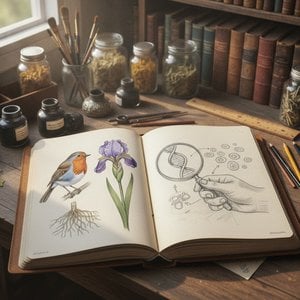
The Botanical World Illuminated: The Life and Art of Georg Dionysius Ehret
Georg Dionysius Ehret, a name synonymous with precision and artistry in the realm of botanical illustration, flourished during the 18th century—a period marked by burgeoning scientific inquiry and an insatiable curiosity about the natural world. Born in Heidelberg, Germany, in 1708, Ehret’s path to becoming one of history's most celebrated botanical artists was deeply rooted in a familial connection to horticulture. His father, Ferdinand Christian Ehret, wasn’t merely a gardener but a skilled draughtsman, instilling in young Georg an early appreciation for both the beauty and structural intricacies of plants. This foundational upbringing, combining practical horticultural knowledge with artistic training, would prove pivotal in shaping his future career.
Ehret's initial steps into the world of botanical art were profoundly influenced by a collaboration that would define much of his early success: his work alongside Carl Linnaeus and George Clifford. Between 1735 and 1736, he found himself at Hartecamp, the magnificent estate of George Clifford, a wealthy Dutch banker with an ardent passion for botany. This environment was a veritable paradise for a budding botanical artist—a treasure trove of exotic plants and an extensive herbarium providing endless inspiration. It was here, under Linnaeus’s guidance, that Ehret honed his skills, contributing significantly to the creation of Hortus Cliffortianus, published in 1738. This landmark publication wasn't simply a catalog of plants; it was a visual masterpiece, celebrated for its meticulous detail and artistic flair—a testament to Ehret’s burgeoning talent and Linnaeus’s revolutionary system of plant classification.
A Journey Marked by Innovation and Independence
Despite the triumph of Hortus Cliffortianus, Ehret's career wasn’t without its challenges. A dispute with Johann Wilhelm Weinmann over a large-scale commission—Ehret completed 500 plates before abandoning the project due to perceived exploitation—prompted a significant shift in his life. He made the pivotal decision to relocate to England, seeking new opportunities and artistic freedom. This move proved transformative. In England, Ehret found himself in demand, illustrating spectacular plants cultivated in British gardens and private collections. His style continued to evolve, characterized by an unwavering commitment to botanical accuracy coupled with a refined aesthetic sensibility.
Ehret’s artistic approach wasn't merely about replicating what he saw; it was about understanding the underlying structure of each plant, capturing its essence with both scientific precision and artistic grace. He skillfully rendered textures, colors, and forms, bringing to life the delicate beauty of petals, the intricate patterns of leaves, and the subtle nuances of stems. His illustrations weren’t simply records—they were celebrations of nature's artistry. This dedication to detail and accuracy resonated deeply with botanists and collectors alike, solidifying his reputation as a leading botanical artist of his time.
Legacy and Lasting Influence
Georg Dionysius Ehret’s contributions extended far beyond the creation of beautiful illustrations. He played a crucial role in visually representing Linnaeus's system of plant classification, aiding its widespread adoption by providing clear, accurate depictions of botanical specimens. His work wasn’t just aesthetically pleasing; it was scientifically valuable, serving as an essential resource for botanists and researchers. In recognition of his contributions to botany, the genus Ehretia was named in his honor—a lasting tribute to his legacy.
Today, Ehret's original artwork is held in prestigious institutions worldwide, including the Natural History Museum (London), Royal Botanic Gardens (Kew), and Hunt Institute for Botanical Documentation (Pittsburgh). These collections stand as a testament to his enduring influence on botanical art. A memoir of his life, published in the Proceedings of the Linnean Society of London in 1984-1985, further cemented his place in scientific history. Ehret’s meticulous technique and dedication to accuracy continue to inspire artists and botanists alike, ensuring that his legacy as a master of botanical illustration will endure for generations to come.
Major Works & Artistic Style
- Hortus Cliffortianus (1738): A collaborative masterpiece with Carl Linnaeus, showcasing detailed illustrations of plants from George Clifford’s collection. This work is considered a cornerstone of early botanical literature.
- Plantae Selectae (1750-1773): A series illustrating rare and exotic plants cultivated in British gardens, demonstrating Ehret's ability to capture the beauty and diversity of plant life.
- Illustrations for Philip Miller’s Gardener’s Dictionary: Ehret contributed significantly to this influential horticultural publication, providing accurate depictions of various plants.
- Ehret’s style is characterized by: Meticulous detail, scientific accuracy, artistic flair, skillful rendering of textures and colors, and a deep understanding of plant structure.
الأسئلة والأجوبة
هل يوجد تسلسل زمني لمسيرة Georg Dionysius Ehret؟
تُعد مسيرة فنية الخاصة بـ Georg Dionysius Ehret خطاً زمنياً تفاعلياً يعرض أعمال الفنان بترتيب زمني، مقسمة إلى فصول تمثل مراحل مسيرته المهنية.
أين يمكن العثور على أعمال Georg Dionysius Ehret الفنية مصنفة حسب التقنية؟
للعثور على جميع أعمال Georg Dionysius Ehret حسب الوسيط الفني، يرجى زيارة صفحة حسب الوسيط الفني الخاصة بالفنان.
هل يمكنني تصفح أعمال Georg Dionysius Ehret حسب الحالة المزاجية؟
تستعرض صفحة ركن الأجواء الخاصة بالفنان أعمال Georg Dionysius Ehret الفنية مرتبة حسب أجوائها.