Ernest Charles Walbourn: A Painter of English Pastoral
Ernest Charles Walbourn, a British landscape painter active primarily in the late 19th and early 20th centuries, possessed a remarkable ability to capture the serene beauty and quiet dignity of rural England. Born in Dalston, Middlesex, on February 16, 1872, into a family with connections to Tasmania, Walbourn’s artistic journey began not as a predetermined path but as a personal pursuit against his father's initial reservations. His early life, marked by a supportive environment and access to art training, laid the foundation for a career dedicated to depicting scenes of idyllic countryside life – a genre deeply rooted in Victorian sensibilities yet imbued with a subtle romanticism.
Walbourn’s artistic development was significantly shaped by his relocation to Chingford, Essex, in 1895. This move provided him with a studio within the family home and crucial financial support, allowing him to fully dedicate himself to painting. His early exhibitions at the Royal Institute of Oil Painters and subsequently at the Royal Academy established a solid reputation, attracting collectors who appreciated his meticulous detail and evocative use of light and color. He skillfully blended academic techniques with a distinctly personal style, creating works that resonated with a longing for simpler times – a sentiment particularly poignant during an era of rapid industrialization and social change.
The Influence of Barbizon Realism
Walbourn’s work is firmly situated within the broader context of Barbizon School painting. Like his contemporaries, including Charles-François Daubigny, he prioritized direct observation of nature and a rejection of overly polished academic styles. However, Walbourn's approach was characterized by an even greater emphasis on capturing atmospheric effects – the subtle shifts in light and shadow that define the English countryside. His paintings are not merely representations of landscapes; they are imbued with a sense of mood and atmosphere, conveying a feeling of tranquility and timelessness.
The influence of Charles Darwin is also subtly present in Walbourn’s work. His depictions of rural life often portray a harmonious relationship between humanity and nature – a reflection of the Victorian fascination with natural history and the belief in the inherent goodness of the natural world. This connection to the land, combined with his technical skill, resulted in paintings that were both aesthetically pleasing and intellectually engaging.
Key Works and Artistic Techniques
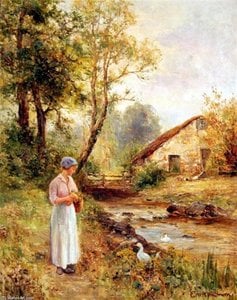
Several of Walbourn’s works stand out for their exceptional quality and evocative power. “Backyard,” a particularly compelling example, captures the quiet beauty of a rural setting with remarkable realism and attention to detail. The painting's warm tones and subtle lighting create a sense of intimacy and serenity, inviting the viewer to step into another world. Similarly, his depictions of farm scenes – often featuring young women tending to livestock or gathering flowers – are imbued with a gentle charm and a nostalgic quality.
Walbourn’s technical skill is evident in his masterful use of color, brushwork, and composition. He employed loose, expressive brushstrokes to capture the textures of foliage, soil, and water, while carefully balancing light and shadow to create depth and atmosphere. His ability to render the subtle nuances of natural light was particularly noteworthy, contributing significantly to the overall mood and impact of his paintings.
Legacy and Recognition
Despite facing challenges during his lifetime – including a lack of formal artistic training and the initial disapproval of his father – Ernest Charles Walbourn achieved considerable recognition for his work. His paintings were exhibited at prestigious venues, sold to discerning collectors, and included in the collections of notable museums, such as the Bolton Museum and the Herbert Art Gallery & Museum. His legacy endures through his evocative depictions of English pastoral life, which continue to resonate with viewers today.
Walbourn’s story serves as a testament to the power of perseverance and the enduring appeal of art that celebrates the beauty and tranquility of the natural world. His paintings offer a glimpse into a bygone era – a time when rural England was viewed with both admiration and nostalgia, and when artists sought to capture its essence on canvas.
الأسئلة والأجوبة
هل يمكنني تصفح أعمال Ernest Charles Walbourn حسب الحركة الفنية؟
يمكن تصفح أعمال Ernest Charles Walbourn حسب الحركة الفنية عبر صفحة جميع المدارس الفنية.
أين يمكنني استعراض جميع أعمال Ernest Charles Walbourn الفنية؟
يمكن تصفح جميع أعمال Ernest Charles Walbourn على هذا الموقع عبر صفحة كافة الأعمال الفنية الخاصة بالفنان.
هل تتوفر جولة افتراضية ثلاثية الأبعاد لأعمال Ernest Charles Walbourn؟
يمكنكم القيام بزيارة افتراضية: حيث تستعرض صفحة متحف ثلاثي الأبعاد الخاصة بـ Ernest Charles Walbourn أعمال الفنان في معرض ثلاثي الأبعاد.