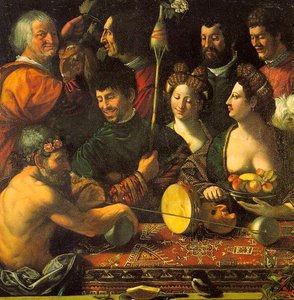
Dosso Dossi (c. 1489-1542): A Visionary of Ferrara’s Renaissance
Giovanni di Niccolò de Luteri, universally known as Dosso Dossi, stands as a pivotal figure in the artistic landscape of the Italian Renaissance, specifically within the vibrant School of Ferrara. Born around 1489 in San Giovanni del Dosso, Italy, his life coincided with an era defined by humanist ideals and burgeoning artistic innovation—a period profoundly shaped by the patronage of Alfonso I dEste, Duke of Ferrara. While biographical details remain somewhat sparse, Dossi’s legacy rests firmly on his breathtaking canvases that capture the spirit of his time, blending mythological grandeur with subtle Venetian influences and a distinctive dreamlike quality.
- Early Life & Training: Precise information regarding Dossi's formative years is elusive. He apprenticed under Andrea Mantegna in Mantua, absorbing the master’s meticulous attention to detail and mastery of perspective—techniques that would become hallmarks of his own oeuvre. This exposure undoubtedly instilled a foundational understanding of classical art principles and established him as part of a burgeoning artistic community eager to explore new expressive possibilities.
- The School of Ferrara: Dossi's career truly blossomed in Ferrara, where he became a leading artist alongside Titian and Giorgione—a collective known as the Scuola di Ferrara. This influential group championed a revolutionary approach to painting, prioritizing atmospheric perspective and luminous color palettes over traditional realism. They sought to evoke emotion and psychological depth through their compositions, mirroring the humanist preoccupation with human experience.
- Mythological Visions & Venetian Influence: Dossi’s artistic output is dominated by mythological scenes—often imbued with allegorical meaning—that depict heroic figures engaged in dramatic narratives. However, his style wasn't solely rooted in classical tradition; he skillfully incorporated elements of Venetian painting, particularly the shimmering colors and hazy landscapes favored by Giorgione and Titian. This fusion created a uniquely captivating visual language that distinguishes him from many of his contemporaries.
- Notable Works: Among Dossi’s celebrated masterpieces are “Circe (or Melissa),” depicting the sorceress Circe transforming Odysseus's men into swine, and “Jupiter, Mercury and the Virtue,” showcasing Zeus overseeing the bestowal of virtue upon mankind. These paintings exemplify his masterful command of composition, color theory, and psychological portrayal—demonstrating a profound understanding of artistic conventions while simultaneously forging an individual style.
- Legacy & Historical Significance: Dosso Dossi’s contribution to Renaissance art extends beyond mere stylistic innovation; he helped propel Ferrara into the cultural spotlight as a center for artistic excellence. His work continues to inspire admiration for its beauty and intellectual depth, serving as a testament to the transformative power of humanist ideals and the enduring fascination with classical mythology. He remains an artist whose vision captured the essence of his era—a visionary who cemented his place in art history.