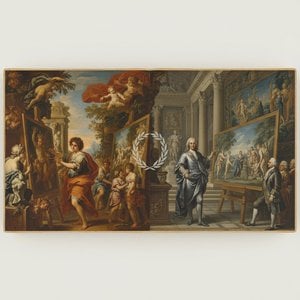
Vue De Metz Depuis La Colline Bellecroix Anciennement
The Martyrdom Of Saint Catherine
Lifespan: 54 years
Copyright status: Public domain
Nationality: Italy
The Enigmatic Wanderer of the Baroque
Didier Barra remains an artist shrouded in a profound and captivating mystery, his life a series of shadows cast by the remarkable brilliance of his surviving works. Born around 1590 in the quiet environs of Metz, Lorraine—then part of the Duché de Lorraine—Barra’s early years are largely lost to the mists of time, leaving historians to reconstruct his trajectory through the very brushstrokes he left behind. Around 1608, he embarked on a transformative journey toward Italy, a migration that would fundamentally alter his artistic soul. Upon arriving in Naples, a city then pulsating with the vibrant energy of the Baroque era, Barra found more than just a new home; he found a canvas for a vision that was uniquely his own, blending the meticulous precision of his French roots with the dramatic, emotive intensity of the Italian landscape.
Visions of Decay and Sublime Grandeur
To encounter a Barra landscape is to step into a world caught in the silent, slow-motion collapse of time itself. He achieved a singular renown for his cityscapes—visions of crumbling towers and desolate, near-barren buildings that evoke an unsettling, almost post-apocalyptic atmosphere. His palette was intentionally austere, dominated by the somber tones of muted browns, ochres, and grays, which served to heighten the psychological weight of his compositions. Through a masterful command of perspective, Barra created architectural sentinels that seem both mighty and melancholic, inviting the viewer to contemplate the inevitable decay of human endeavor. In works such as Landscape with Buildings, one observes an incredible interplay between the sharp, weathered textures of stone and a soft, atmospheric haze that suggests the heavy, humid air of the Mediterranean. These were not merely depictions of ruins; they were psychological landscapes where the grandeur of the past meets the haunting stillness of a world ravaged by time.
The Shadow of Monsù Desiderio
For centuries, the true identity of this master was obscured by a collective misattribution. Until the mid-twentieth century, much of Barra’s extraordinary output was credited to a single, mythical figure known as Monsù Desiderio. It was only through rigorous modern scholarship that the veil was lifted, revealing that this singular "hand" was actually the work of several distinct artists, with Didier Barra standing as one of its most vital contributors alongside figures like François de Nomé. This revelation has reshaped our understanding of the Neapolitan school, transforming a single legend into a complex tapestry of individual genius. Today, Barra is celebrated not just for his technical skill, but for his ability to capture the sublime—that terrifyingly beautiful intersection of awe and dread. His legacy persists in the way he taught us to look at ruins, not as mere debris, but as profound monuments to the fleeting nature of existence.
بقلم فريق تحرير WahooArt.com
اختبار الفنون
يوجد إجابة صحيحة واحدة فقط لكل سؤال.
سؤال 1:
Where was Didier Barra born?
سؤال 2:
In which city did Didier Barra achieve significant success as a painter?
سؤال 3:
What was Didier Barra primarily known for painting?
سؤال 4:
Around what year did Didier Barra leave Metz for Italy?
سؤال 5:
Didier Barra collaborated with another artist named François de Nomé.
اكتشف سحر الباروك! دليل شامل حول الحركة الفنية، عناصرها الجمالية، وكيفية دمج فخامتها وعاطفتها في الدواخل المعاصرة. نصائح من خبراء WahooArt لإضفاء لمسة باروكية على منزلك.
Explore the dramatic world of Baroque art! Discover iconic artists like Caravaggio & Rubens, defining techniques, and its lasting impact on art history. Expert insights for collectors & enthusiasts at WahooArt.
Explore the life & art of Simon Vouet, a pivotal French Baroque painter who introduced Italian styles to France. Discover his masterpieces and lasting influence on 17th-century art.