Clement McAleer: Weaver of Layers, Explorer of the Soul
Clement McAleer (born 1949) is a profoundly evocative Irish artist whose work has captivated audiences for decades. He’s not merely a painter; he's a storyteller, meticulously constructing layered narratives within his signature polyptychs – large-scale panel paintings that unfold like illuminated manuscripts or complex tapestries. McAleer’s art isn’t about depicting reality in a straightforward manner; it’s an invitation to delve into the depths of human experience, exploring themes of spirituality, nature's enduring power, and the intricate connections between memory, faith, and the passage of time.
Born in County Donegal, Ireland, McAleer’s artistic journey began with a deep connection to the rugged landscape and ancient traditions of his homeland. His early influences were diverse – from the vibrant colors of Celtic mythology and folklore to the stark beauty of the Irish coastline and the profound spirituality rooted in its history. This formative environment instilled within him a reverence for storytelling, symbolism, and the power of visual language to convey complex emotions and ideas. He initially studied at the Limerick School of Art & Design, but it was his subsequent travels through Europe – particularly Italy – that profoundly shaped his artistic vision. The Renaissance art he encountered there, with its emphasis on perspective, light, and narrative, became a crucial element in his own approach to composition and storytelling.
The Polyptych: A Structure of Meaning
McAleer’s most distinctive feature is undoubtedly the polyptych format. Rather than presenting a single image, he creates a series of panels – typically six or more – that are arranged in a linear sequence. Each panel contributes to a larger, interconnected narrative, building upon previous images and revealing new layers of meaning as the viewer progresses through the work. This deliberate fragmentation mirrors the way memory itself works—not as a continuous stream but as a collection of disparate fragments that coalesce into a coherent whole. The use of color is particularly significant within this structure; McAleer employs a rich, almost luminous palette, often utilizing variations in tone and hue to create a sense of depth and movement across the panels.
The technique itself is meticulously executed. He begins with an underpainting, building up layers of oil paint using both brushwork and glazing techniques. This layering process allows him to achieve incredible detail and luminosity, while also creating a subtle sense of atmosphere and texture. McAleer’s work isn't about sharp outlines or precise representation; it’s about capturing the *feeling* of a place or moment—the light, the shadows, the emotional resonance.
Themes of Faith, Nature, and Memory
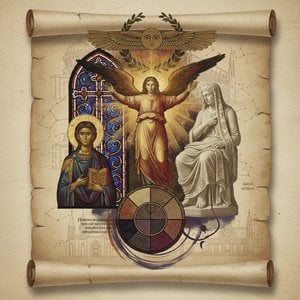
While McAleer’s art is often described as abstract expressionist, it resists easy categorization. It's more accurately characterized by its deeply symbolic nature and its exploration of universal themes. Recurring motifs in his work include biblical imagery, Celtic mythology, and natural elements—particularly the sea, sky, and landscape. He frequently incorporates symbols drawn from Christian iconography – crosses, angels, saints – but rarely in a literal or didactic manner. Instead, these images serve as anchors for exploring broader questions of faith, morality, and the human condition.
McAleer’s work is deeply rooted in memory—both personal and collective. He often references his childhood experiences in Donegal, evoking a sense of nostalgia and longing for a lost past. However, he also engages with larger historical narratives, drawing inspiration from Irish folklore, religious history, and the struggles of his people. His paintings are not simply representations of these themes; they’re invitations to contemplate their enduring relevance.
Notable Works and Legacy
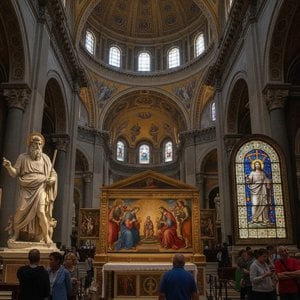
Among McAleer's most celebrated works is “Beach” (a polyptych from the Royal Liverpool Hospital collection), a stunning depiction of a coastal sunset that captures both the beauty and melancholy of the natural world. “San Clemente,” inspired by the Basilica in Rome, showcases his ability to blend historical references with symbolic imagery. His series "Shoreline" further explores the relationship between humanity and the environment. These works, along with many others, have been exhibited widely throughout Europe and North America, earning him critical acclaim and establishing him as one of Ireland’s leading contemporary artists.
Clement McAleer's art continues to resonate deeply with audiences today because it speaks to fundamental human concerns—our connection to nature, our search for meaning, and our enduring fascination with the past. His polyptychs are not merely paintings; they are immersive experiences that invite viewers to embark on a personal journey of discovery.
الأسئلة والأجوبة
أين يمكنني مشاهدة أعمال Clement Mcaleer الفنية في معرض ثلاثي الأبعاد؟
يمكن مشاهدة أعمال Clement Mcaleer الفنية في معرض ثلاثي الأبعاد عبر صفحة متحف ثلاثي الأبعاد الخاصة بالفنان.
أين يمكن العثور على أعمال Clement Mcaleer الفنية مصنفة حسب لوحة الألوان؟
للعثور على أعمال Clement Mcaleer ضمن لوحة ألوان محددة، يرجى زيارة صفحة حسب لوحة الألوان الخاصة بالفنان.
كيف تنقسم المسيرة المهنية لـ Clement Mcaleer إلى فترات زمنية؟
تُعد سجل زمني الخاصة بـ Clement Mcaleer خطاً زمنياً يعتمد على التمرير، حيث تعرض أعمال الفنان بترتيب زمني، مقسمة إلى فصول تمثل مراحل مسيرته المهنية.