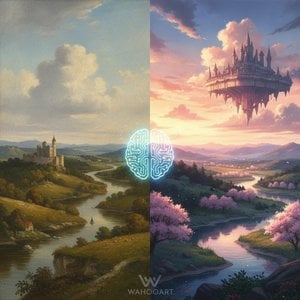
Chuzo Tamotzu: Bridging Worlds Through the Lens of Nature
Born in 1888 on the remote island of Amami Ōshima, Japan, Chuzo Tamotzu’s artistic journey was one shaped by a profound curiosity and an unwavering commitment to capturing the essence of both Eastern and Western landscapes. Initially drawn to traditional Japanese arts like Sumi ink painting and Shakuhachi flute playing, his travels throughout Asia and Europe in the early 20th century ignited a desire for broader understanding – a yearning to synthesize diverse artistic traditions into a uniquely personal vision. This restless spirit ultimately led him to New York City in 1920, where he would spend two decades honing his craft and establishing himself as a significant figure within the burgeoning American art scene.
Tamotzu’s early career was marked by a deliberate engagement with avant-garde movements. He became associated with groups like An American Group, absorbing influences from Cubism and Expressionism while simultaneously retaining a deep connection to his Japanese heritage. His work during this period often featured bold, simplified forms and vibrant colors, reflecting the dynamism of urban life alongside a nostalgic longing for the tranquility of nature. He sought not merely to depict scenes but to convey an emotional resonance – a sense of quiet contemplation and profound connection with the natural world.
The Impact of the New Deal and Wartime Service
The Great Depression brought both challenges and opportunities. Tamotzu’s artistic skills were recognized by the Public Works of Art Project, affording him a brief period of employment during a time of widespread economic hardship. However, his status as an immigrant ultimately prevented him from fully participating in the Works Progress Administration, a poignant reflection of the prejudices prevalent at the time. Despite this setback, Tamotzu’s dedication to art remained steadfast.
During World War II, he served with distinction as a combat sketch artist for the Office of Strategic Services (OSS), producing evocative drawings intended to bolster morale and psychological warfare efforts against the Japanese army. This experience profoundly shaped his perspective, instilling in him a deep appreciation for the fragility of peace and the importance of human connection. It’s important to note that these wartime sketches, while serving a strategic purpose, also reveal a remarkable sensitivity to detail and an ability to capture the emotional weight of conflict.
Settlement in Santa Fe and a Legacy of Connection
In 1948, Tamotzu relocated to Santa Fe, New Mexico, seeking a more contemplative environment. It was here that he truly found his artistic voice, developing a distinctive style characterized by luminous color palettes, loose brushwork, and an intimate portrayal of the Southwest’s rugged landscapes – mesas, canyons, and juniper-studded hillsides. He became deeply involved in the local art community, establishing the Tamotzu Gallery and fostering connections with other artists and educators.
Perhaps his most enduring legacy stems from his 1953 initiative: an exchange art program between children of Santa Fe and Hiroshima. Recognizing that young people held the key to bridging cultural divides, he organized a remarkable event where children from both cities exchanged drawings, fostering a sense of shared humanity and mutual understanding. This project, documented in numerous publications and exhibitions, stands as a testament to Tamotzu’s belief in the power of art to transcend political boundaries and promote peace.
Key Characteristics and Artistic Style
Tamotzu's artistic style evolved significantly throughout his career, yet certain recurring elements consistently defined his work. He favored plein air painting – working directly from nature – allowing him to capture the fleeting effects of light and atmosphere with remarkable precision. His use of color was particularly noteworthy; he employed a vibrant palette, often layering hues to create luminous surfaces that seemed to radiate warmth and vitality. His compositions were typically characterized by a sense of spaciousness and depth, inviting the viewer to lose themselves in the details of the landscape.
Furthermore, Tamotzu’s work is distinguished by its emotional resonance. He wasn't simply rendering scenes; he was conveying a feeling – a sense of serenity, wonder, or quiet contemplation. His paintings invite viewers to connect with the natural world on a deeply personal level, reminding us of the beauty and fragility of our planet.
Chuzo Tamotzu’s life and work represent a remarkable synthesis of Eastern and Western influences, shaped by travel, war, and a profound commitment to artistic expression. His legacy endures not only through his paintings but also through his unwavering belief in the power of art to foster understanding, empathy, and peace – values that remain profoundly relevant today.