The Belgian Realist's Direct Vision
To understand Camille Van Camp is to look past the romanticized haze of nineteenth-century landscape painting and confront the grit of Belgian Realism. Born in Tongeren, this painter did not merely observe nature; he participated in its structural reality. His training at the Académie royale des Beaux-Arts de Bruxelles under François-Joseph Navez, Louis Gallait, and Louis Huard provided a technical foundation that allowed him to move beyond simple imitation. He was a man of diverse disciplines—a portraitist, watercolorist, and engraver who understood the weight of a line as much as the softness of light.
His work carries the unmistakable imprint of his travels. By studying the Old Masters at the Uffizi in Florence and the Louvre in Paris, Van Camp absorbed a classical rigor that he later applied to more modern, earthier subjects. He did not seek to idealize the world. Instead, his time spent in Tervuren alongside Hippolyte Boulenger helped him anchor himself in the School van Tervuren, a movement defined by its connection to the local landscape and a rejection of academic artifice.
Technical Versatility and the Tervuren Influence
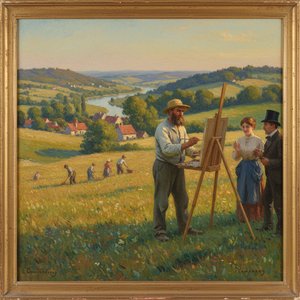
Van Camp’s output was remarkably broad, spanning oil on canvas, watercolor, and intricate engravings. This versatility was not a sign of lack of focus but rather a deliberate engagement with different textures of reality. As an aquafortiste and illustrator, he possessed a precision that translated well to the more rugged demands of landscape painting. His brushwork often utilized large strokes and light tones, a technique that allowed him to capture the atmospheric shifts of the Belgian countryside without losing the physical presence of his subjects.
The artist was deeply embedded in the institutional fabric of his era. He was a co-founder of the Société Libre des Beaux-Arts in 1868 and later became the first president of the Société des Aquafortistes belges in 1886. These were not merely social positions; they were active attempts to promote a realist aesthetic against the prevailing academicism of the time. His role as a critic for L’Art libre further demonstrates his commitment to shaping the discourse of Belgian art through direct, often sharp, observation.
A Legacy of Observation
The significance of Van Camp lies in his ability to bridge the gap between different artistic currents. While he drew strength from the Barbizon School and showed traces of Impressionist influence, his heart remained tied to the objective representation of his surroundings. His subjects ranged from the monumental—such as large-scale historical scenes like La Mort de Marie de Bourgogne—to the intimate, including portraits of family members and sketches of daily life.
His death in Montreux, Switzerland, ended a career that had successfully navigated the complexities of late nineteenth-century art. He left behind a body of work that remains a vital record of Belgian landscape and portraiture. His contributions are found in major collections including:
- Musée royal des Beaux-Arts d'Anvers
- Musées royaux des Beaux-Arts de Belgique
- Hôtel de Ville de Bruges
- Palais de la Nation, Bruxelles