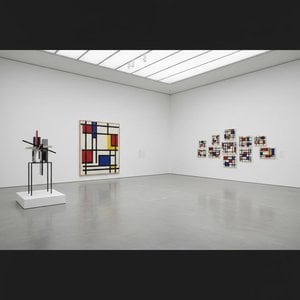
Composition in Grey and Ochre: A Cornerstone of Neoplasticism
Piet Mondrian, born Pieter Cornelis Mondriaan in 1872 amidst the tranquil Dutch landscape of Amersfoort, embarked on an artistic journey far removed from immediate acclaim. His familial connection to Frits Mondriaan, a respected painter himself, initially guided him toward landscapes steeped in Impressionistic influences – canvases like *The Red Mill*, diligently capturing the nuances of Dutch scenery. Yet, beneath this surface mastery lay a persistent desire for simplification; Mondrian wasn’t merely replicating nature's beauty but striving to distill its core essence into pure geometric form. This early experimentation encompassed Pointillism and Fauvism, each offering distinct perspectives on color and composition—styles that probed the boundaries of artistic expression without fully resonating with his evolving vision.
- Style: Neoplasticism – Mondrian’s revolutionary approach sought to transcend representational art by reducing visual elements to their fundamental building blocks: straight lines, rectangles, and primary colors (red, yellow, blue).
- Technique: Executed in oil on canvas, Composition with Grid No. 1 demonstrates meticulous attention to detail—particularly the application of dark grey pigment to delineate rectangular areas against a subtly textured ochre background.
The Genesis of Geometric Harmony
The painting’s creation coincided with Mondrian's fervent belief in De Stijl, an artistic collective founded alongside Theo van Doesburg in 1917. This movement championed the unification of material and spiritual realms through geometric abstraction, profoundly impacting art, architecture, and design. The guiding principle was to transform societal perception by reshaping environments—a bold ambition fueled by a conviction that visual harmony could foster intellectual clarity and emotional balance. X-ray photography revealed an astonishing secret: the grid pattern wasn’t accidental but meticulously calculated using the golden ratio – a mathematical proportion considered aesthetically pleasing throughout history.
Symbolism Beyond Representation
Composition with Grid No. 1 transcends mere visual beauty; it embodies profound symbolic significance. The absence of organic forms—no trees, no flowers, no human figures—reflects Mondrian’s rejection of illusionistic depiction in favor of conveying universal truths through abstract geometry. Each rectangle represents a building block of existence, symbolizing stability and order – concepts central to De Stijl's utopian aspirations for a harmonious society. The restrained color palette—primarily grey and ochre—further underscores this ethos, prioritizing clarity and purity over sensory stimulation.
A Legacy Enduring Through Reproduction
Displayed initially at an exhibition organized by the Dutch Artists’ Circle in Amsterdam in 1919, Composition with Grid No. 1 gained prominence after being acquired by Pierre Schlumberger and subsequently donated to The Museum of Fine Arts, Houston in 1963. Its enduring appeal lies not only in its artistic merit but also in its role as a pivotal milestone in the history of modern art—a testament to Mondrian’s unwavering commitment to simplifying visual experience and achieving sublime geometric harmony. Today, WahooArt offers exceptional reproductions that allow collectors and enthusiasts alike to appreciate this masterpiece's timeless elegance and intellectual depth.



 معاينة الحجم الحقيقي
 اشترِ نسخة مطبوعة
 مشاركة
 مشاركة
 التفاصيل

 تحميل الملف
 قطع مشابهة
 الأشعة السينية
 عرض شرائح

 عرض المزيد






































 خيار الزجاج متاح فقط للمقاسات التي تقل عن 110 سم