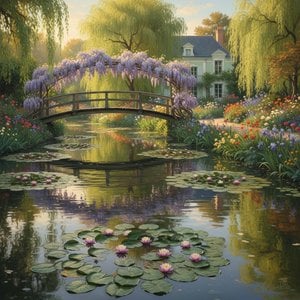
The Path Under the Rose Arches: A Giverny Reverie
Claude Monet’s “The Path under the Rose Arches,” painted in 1918, isn't merely a depiction of a garden scene; it’s an immersion into a world of light, color, and memory. Housed within the Musée Marmottan Monet in Paris, this oil on canvas offers a poignant glimpse into the artist’s later years and his enduring fascination with Giverny, the sanctuary he meticulously crafted as both home and studio. More than just a landscape, it's a testament to Monet’s revolutionary approach to painting – an attempt to capture not just what he *saw*, but how he *felt* about what he saw, a core tenet of Impressionism.
The composition immediately draws the eye along the gently curving path, flanked by the vibrant orange hues of meticulously cultivated trees. These aren’t simply trees; they are bursts of color, strategically placed to create an inviting and almost dreamlike atmosphere. The empty path itself acts as a visual invitation, beckoning the viewer into Monet's private world – a space deliberately devoid of human presence, emphasizing tranquility and solitude. Notice the subtle branching paths that lead off the main route, adding layers of depth and complexity to the scene, mirroring perhaps the intricate network of thoughts and emotions that shaped Monet’s artistic vision.
Monet’s Series and the Language of Light
Understanding “The Path under the Rose Arches” requires acknowledging Monet's innovative approach to painting – his embrace of "series paintings." Throughout his career, he repeatedly returned to single subjects—haystacks, cathedrals, water lilies—exploring their variations under different lighting conditions and throughout the seasons. This wasn’t simply repetition; it was a deliberate investigation into the very nature of perception. In this particular work, Monet is less concerned with photographic accuracy than with conveying the *impression* of light and atmosphere at a specific moment in time. The loose brushstrokes, almost dissolving into one another, are characteristic of Impressionism – capturing fleeting effects rather than solid forms.
The choice of orange trees is particularly significant. Monet’s garden at Giverny was renowned for its exotic plantings, and the vibrant color of these trees served as a deliberate contrast to the surrounding greens, intensifying the overall visual impact. This careful orchestration of color reflects Monet's deep understanding of how light interacts with different hues – a skill honed through years of dedicated observation and experimentation.
A Giverny Portrait in Paint
“The Path under the Rose Arches” offers a poignant window into Monet’s later life. Painted in 1918, during a period marked by personal loss and declining eyesight, it reveals an artist still deeply connected to his beloved garden. The scene isn't grand or dramatic; instead, it exudes a quiet serenity – a reflection of the emotional landscape of a man grappling with mortality. It’s important to note that Monet was working in his late 70s at this time, and the painting demonstrates an incredible level of control and artistic maturity despite these physical challenges.
The Musée Marmottan Monet provides invaluable context for appreciating this work. The museum houses a vast collection of Monet’s paintings, including numerous studies and preparatory sketches that offer insights into his creative process. Visiting Giverny itself – the site of Monet's home and garden – further enhances our understanding of the inspiration behind “The Path under the Rose Arches,” allowing us to experience firsthand the beauty and tranquility that captivated the artist for so many years.
Bringing Monet’s Vision Home
WahooArt offers meticulously crafted, hand-painted reproductions of "The Path under the Rose Arches," capturing the essence of Monet's Impressionistic style with remarkable fidelity. Whether you are an art enthusiast, a collector seeking to expand your collection, or simply someone looking to infuse your home with beauty and tranquility, our reproduction provides a stunning way to experience this iconic masterpiece. Each reproduction is created using archival-quality materials, ensuring that it will retain its vibrancy and detail for generations to come. Explore the full range of sizes and options available on WahooArt.com – and step into Monet’s world.



 معاينة الحجم الحقيقي
 التحويل إلى المطبوعات
 مشاركة
 مشاركة
 التفاصيل

 تحميل الملف
 قطع مشابهة
 الأشعة السينية
 عرض شرائح
 الإحصائيات


 عرض المزيد






































 خيار الزجاج متاح فقط للمقاسات التي تقل عن 110 سم