A Life Painted in Light: The World of Samuel Colman
Samuel Colman, born in Portland, Maine, in 1832, was a figure who gracefully navigated the evolving currents of 19th-century American art. He wasn’t simply a painter; he was an explorer of mediums, a keen observer of cultures, and ultimately, a polymath whose artistic pursuits extended far beyond the canvas. His early life, steeped in the literary atmosphere of his father's bookstore in New York City, undoubtedly fostered a sensibility that would inform his later work – a sensitivity to narrative, detail, and the power of visual storytelling. While he received foundational training under Asher Durand, a cornerstone of the Hudson River School, Colman quickly began forging his own path, one characterized by an insatiable curiosity and a willingness to embrace new influences.
From American Landscapes to Global Visions
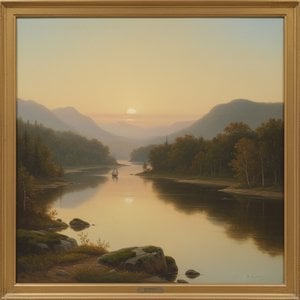
Colman’s initial artistic endeavors firmly placed him within the tradition of the Hudson River School. Paintings like “Meadows and Wildflowers at Conway” (1856) exemplify this early style – meticulous depictions of the American landscape, imbued with a romantic sensibility that celebrated the nation's natural beauty. However, unlike some of his contemporaries who remained devoted to purely domestic subjects, Colman possessed an adventurous spirit that propelled him across continents. His extensive travels throughout Europe in the 1860s and early 1870s – encompassing France, Spain, Italy, Morocco, Egypt, Holland, and Algeria – proved transformative. These journeys weren’t merely sightseeing expeditions; they were immersive studies of light, color, architecture, and culture. He began to incorporate architectural elements into his paintings—cityscapes, castles, bridges—reflecting a broadening artistic vision. This shift is evident in works depicting scenes from the Mediterranean, where he masterfully captured the interplay between ancient structures and vibrant local life. Later journeys to the American West further expanded his repertoire, yielding landscapes that rivaled those of Thomas Moran in scope and dramatic impact.
A Champion of Watercolor and Beyond
Colman’s contributions weren't limited to oil painting. He was a passionate advocate for watercolor, recognizing its unique potential as a fine art medium. In 1866, he co-founded the American Watercolor Society, becoming its first president and tirelessly championing the cause of this often-underappreciated technique. His skill in watercolor is remarkable; his works demonstrate a delicate balance between spontaneity and control, capturing fleeting moments of light and atmosphere with breathtaking precision. Beyond painting, Colman was also an accomplished etcher, producing popular prints that further disseminated his artistic vision. But even as he excelled in these traditional mediums, his interests continued to diversify. In the 1880s, he transitioned into interior design, collaborating with Louis Comfort Tiffany on projects for prominent figures like Samuel Clemens (Mark Twain) and Henry and Louisine Havemeyer. This foray into design showcased his innate understanding of color, form, and spatial harmony.
Scholarship, Geometry, and a Lasting Legacy
In the later years of his life, Colman’s intellectual curiosity led him down increasingly unconventional paths. He amassed an impressive collection of Asian decorative objects, demonstrating a deep appreciation for non-Western art forms. More remarkably, he dedicated himself to exploring the mathematical principles underlying artistic composition, culminating in the publication of two books: “Nature's Harmonic Unity” (1912) and “Proportional Form” (1920). These works reveal a profound belief that beauty is rooted in geometric harmony – a concept that informed his own artistic practice. Samuel Colman passed away in New York City in 1920, leaving behind a rich and varied body of work. His paintings are held in major museum collections, including The Metropolitan Museum of Art and the Smithsonian American Art Museum, ensuring his place as a significant figure in American art history. He stands as a testament to the power of artistic exploration, demonstrating that true creativity knows no boundaries—whether geographical, stylistic, or disciplinary. His legacy is not simply one of beautiful paintings, but of a life lived in pursuit of beauty and understanding.








![Moorish Mosque Of Sidi Halou Tlemcin [tlemcen], Algeria — Samuel Colman](/media/artworks/images/thumbnails/74/d0/74d0163b04e247fd82e032e3c2eb154f.jpg)


