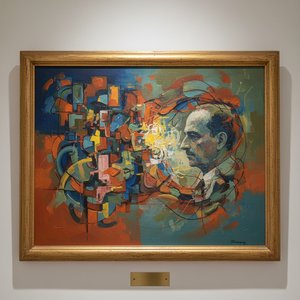
Oscar Dominguez: A Life in Surrealism
Early Life and Artistic Beginnings
Oscar M. Domínguez, a Spanish surrealist painter, was born on January 3, 1906, in San Cristóbal de La Laguna, Tenerife, Canary Islands, Spain. His early life was significantly marked by a serious illness that affected his physical growth, leading to a progressive deformation of his facial bone structure and limbs. This experience profoundly influenced his artistic expression, imbuing it with a sense of fragility and the uncanny.
Artistic Evolution and Influences
Domínguez devoted himself to painting at a young age. At 21, he moved to Paris, immersing himself in the vibrant art scene. He initially worked in the central market of Les Halles while frequenting cabarets at night. This period was crucial for his artistic development as he attended art schools, visited galleries and museums, and drew inspiration from avant-garde painters like Yves Tanguy and Pablo Picasso. His early work showed a clear progression towards abstraction and experimentation with form.
Embracing Surrealism
In 1933, Domínguez met André Breton, the leading theoretician of Surrealism, and poet Paul Éluard. This encounter proved pivotal, solidifying his commitment to the surrealist movement. He actively participated in several key exhibitions, including those held in Copenhagen (1934), London, and Tenerife (1936). His work began to explore themes of dreams, subconscious desires, and the irrational.
Notable Works and Artistic Style
Domínguez developed a distinctive style characterized by dreamlike imagery, distorted forms, and innovative techniques. He is particularly known for his use of decalcomania – a technique involving pressing paint between two surfaces to create unexpected textures and patterns. Some of his most celebrated works include:
- The Infernal Machine (1937): This painting achieved significant recognition, selling for 2,770,000 FF (US $404,375) at auction in 2000.
- Roma's Portrait (1933): Another highly valued work, sold for £902,500 (US $1,469,270) at Christie’s in London in 2014.
Personal Life and Tragic End
Domínguez began a passionate affair with Marie-Laure de Noailles in 1952, who affectionately called him “Putchie.” Sadly, his life was cut short when he committed suicide by slitting his wrists on December 31, 1957. Marie-Laure arranged for his interment in the Bischoffsheim family mausoleum at the Montparnasse Cemetery.
Legacy and Historical Significance
Today, Oscar Domínguez’s works are held in numerous museums and private collections worldwide. His legacy as a Spanish surrealist painter continues to inspire artists and art enthusiasts alike. He is remembered for his unique contribution to the movement, particularly his innovative use of decalcomania and his exploration of psychological themes. His work offers a compelling glimpse into the anxieties and fascinations of the interwar period.