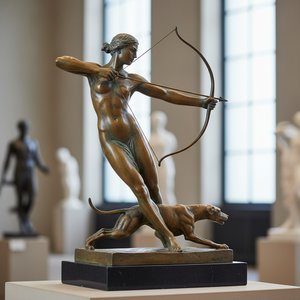
Josep Clarà i Ayats: Sculptor of Mediterranean Grace
Josep Clarà i Ayats (December 16, 1878 – November 4, 1958) stands as a prominent figure in Catalan sculpture, embodying the spirit of his time and leaving an indelible mark on the artistic landscape of Spain. Born in Olot, Girona, Catalonia, Clarà’s formative years were steeped in artistic encouragement—a pivotal moment arriving when Professor Josep Berga i Boix, his mentor at Olot School of Drawing, lauded one of his sketches as a testament to youthful passion and potential. This early admiration fueled his ambition and cemented his dedication to pursuing art as a vocation.
His journey began with enrollment at Toulouse École Supérieure des Beaux-Arts in France in 1897, where he encountered the towering influence of Auguste Rodin, propelling him toward a sculptural path. Furthermore, Clarà forged enduring friendships with sculptor Arístides Maillol, whose aesthetic sensibilities profoundly shaped his artistic vision. He honed his skills under Louis-Ernest Barrias, broadening his understanding of classical techniques and expanding his creative horizons. Notably, Clarà’s fascination with the dancer Isadora Duncan inspired him to capture her dynamic movements in evocative sketches—a testament to his keen observation and artistic sensitivity. Following Duncan's untimely death in 1927, Antonia Mercé served as Clarà’s model, providing invaluable support for his creative endeavors.
Clarà’s artistic development encompassed extensive travels to London and Italy, immersing him in diverse cultural contexts and enriching his artistic repertoire. He returned to Paris, establishing himself as a respected sculptor and garnering recognition for his distinctive style—characterized by solidity, compactness, and an unmistakable Mediterranean resonance. Throughout his career, Clarà participated in numerous exhibitions across Europe, showcasing his work in Paris, London, Berlin, and Barcelona, cementing his reputation as a celebrated artist of his era. In 1932, he permanently relocated to Barcelona, continuing to produce art until his passing on November 4, 1958. His final sculpture, “Estàtica,” exemplifies the culmination of his artistic journey—a poignant reflection of his lifelong pursuit of beauty and form.
Today, Clarà’s sculptures reside primarily in the Museu de la Garrotxa in Olot and the Museu Nacional d'Art de Catalunya in Barcelona, alongside significant pieces housed internationally at institutions such as the Pompidou Centre (Paris), Museo Nacional de Bellas Artes (Santiago de Chile), Museo Nacional de Bellas Artes (Buenos Aires), Museo Nacional de Bellas Artes (Havana), Musée des Augustins (Toulouse), and Museo Nacional Centro de Arte Reina Sofía (Madrid). His legacy continues to inspire artists and scholars alike, securing his place as a cornerstone of Catalan artistic heritage.