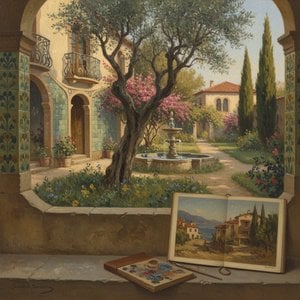
Hermenegildo Anglada Camarasa: A Visionary of Spanish Expressionism
Hermenegildo Anglada Camarasa (1871-1959) stands as a singular figure in Catalan art, celebrated for his mesmerizing blend of vibrant color and fantastical imagery—a style that foreshadowed the groundbreaking innovations of Picasso and Kandinsky. Born in Barcelona, Spain, he honed his artistic skills at the Llotja School, establishing himself as a prominent painter deeply rooted in the traditions of Spanish folklore while simultaneously embracing the burgeoning avant-garde movements of Europe.
- Early Life & Education: Anglada Camarasa’s formative years were marked by exposure to Catalan cultural heritage and artistic experimentation. His training at the Llotja School instilled him with a foundational understanding of academic painting techniques, yet he quickly rejected convention in favor of pursuing his own distinctive vision.
- Influences & Artistic Style: Anglada Camarasa’s oeuvre reveals significant indebtedness to Impressionism and particularly Fauvism—the bold chromatic explorations championed by Matisse and André Derain—and Klimt's opulent decorative style. These influences profoundly shaped his artistic approach, resulting in canvases characterized by luminous hues, stylized forms, and dreamlike atmospheres.
His paintings frequently depict scenes from Spanish mythology and folklore, imbued with symbolic richness and psychological depth. Recurring motifs include dragons, princesses, and fantastical landscapes—elements that transcend mere narrative representation to convey emotional resonance and spiritual contemplation. Anglada Camarasa’s technique involved meticulous layering of pigments, creating textured surfaces that captured the ethereal quality of his visions. He skillfully manipulated color palettes to evoke moods of melancholy, wonder, and ecstasy, mirroring the turbulent currents of artistic thought during his time.
- Notable Works: Among Anglada Camarasa’s most acclaimed paintings are “Old Man,” “View from Montserrat,” and “The Parisian Garden.” Each piece exemplifies his masterful command of color and composition, demonstrating a remarkable ability to distill complex emotions into visually arresting images.
- Legacy & Significance: Anglada Camarasa's artistic legacy extends beyond the confines of Catalan art history. His pioneering use of color and expressive brushwork anticipated developments in Cubism and Surrealism, establishing him as an influential precursor to the modernist movement. He remains a testament to the enduring power of imagination and artistic innovation—a visionary who dared to challenge conventions and forge his own path toward artistic greatness.
Anglada Camarasa’s contribution to art history is undeniable; he wasn't merely replicating reality but actively reshaping it through color and symbolism, leaving an indelible mark on the artistic landscape of the 20th century. His work continues to inspire artists today, reminding us that true artistry lies in embracing boldness and pursuing visions beyond the boundaries of accepted norms.