A Life Immersed in Artistic Harmony
Ignace Henri Jean Théodore Fantin-Latour, born in Grenoble, France, in 1836, was a painter whose life unfolded as a delicate interplay between realism and the burgeoning symbolism of his era. His early artistic inclinations were nurtured by his father, Théodore Fantin-Latour, himself a portrait artist, who provided young Henri with foundational drawing lessons. This familial encouragement propelled him towards Paris in 1850, where he enrolled at the École de Dessin and studied under the innovative Horace Lecoq de Boisbaudran. Lecoq’s unconventional methods—emphasizing drawing from memory rather than strict imitation—instilled in Fantin-Latour a unique approach to observation and representation that would characterize his mature work. He continued his formal training at the École des Beaux-Arts, immersing himself in the study of Old Masters within the hallowed halls of the Louvre, meticulously copying their techniques and compositions. Though he moved among the avant-garde circles that would soon ignite Impressionism—befriending artists like Whistler and Manet—Fantin-Latour charted his own course, remaining steadfastly committed to a more conservative style while subtly absorbing the changing artistic currents around him.The Poetic Still Life and Literary Portraits
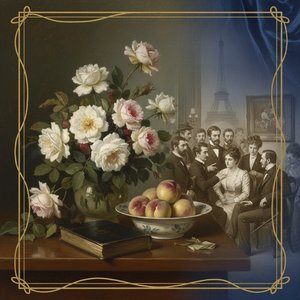
Fantin-Latour’s name is most readily associated with his exquisite still lifes, particularly those featuring flowers. These were not merely botanical studies; they were carefully orchestrated arrangements imbued with a quiet emotional resonance. He elevated the genre beyond simple representation, imbuing each bloom with symbolic weight and exploring nuanced harmonies of color and form. His *Still Life with Flowers and Fruit*, for example, is a testament to his mastery of light and texture, transforming everyday objects into subjects of profound beauty. But Fantin-Latour’s artistic vision extended beyond the floral realm. He became renowned for his evocative portraits, most notably those depicting gatherings of prominent literary and artistic figures. These group compositions—often arranged in the manner of 17th-century Dutch guild portraits—offer a fascinating glimpse into the intellectual life of 19th-century Paris. *By the Table* (1872), capturing a gathering of the Parnassian poets, is perhaps his most celebrated work in this vein, immortalizing figures like Théophile Gautier and Charles Baudelaire with remarkable sensitivity and psychological insight. These portraits weren’t simply likenesses; they were celebrations of creativity and intellectual camaraderie.Bridging Realism and Symbolism
Fantin-Latour occupied a fascinating position in the art world, straddling the boundaries between realism and symbolism. While his meticulous attention to detail and faithful rendering of form align him with realist traditions, his use of color, composition, and subject matter hints at deeper symbolic meanings. The flowers in his still lifes, for instance, were often chosen for their allegorical associations—violets representing humility, lilies symbolizing purity. His portraits, too, weren’t merely representations of individuals but explorations of the creative spirit and the complexities of human relationships. He wasn't driven by a desire to shock or revolutionize like some of his contemporaries; instead, he sought to create works that were both beautiful and intellectually stimulating. This delicate balance—between observation and interpretation, realism and symbolism—is what sets Fantin-Latour apart and contributes to the enduring appeal of his art. He was a master of nuance, subtly infusing his paintings with layers of meaning that reward careful contemplation.Later Years and Enduring Legacy
In 1875, Henri Fantin-Latour married Victoria Dubourg, a fellow painter who would become both his life partner and artistic collaborator. They spent their summers at her family’s estate in Normandy, finding inspiration in the tranquil countryside. During this period, Fantin-Latour increasingly turned to lithography, a medium that allowed him to explore new expressive possibilities. He created striking portraits of composers like Richard Wagner and Hector Berlioz, capturing their personalities with remarkable sensitivity. His lithographs often served as illustrations for biographical works, further cementing his reputation as an artist deeply engaged with the intellectual currents of his time. Fantin-Latour passed away in 1904 at Buré, Orne, leaving behind a body of work that continues to captivate and inspire. His influence can be seen in the works of later artists who sought to combine realism with symbolic meaning, and his paintings remain highly prized by collectors and museums around the world. He stands as a testament to the power of quiet observation, subtle symbolism, and enduring artistic harmony.Key Works & Artistic Connections
- The Palace of Aurora (1873): A captivating Symbolist painting depicting the goddess of dawn, showcasing Fantin-Latour’s dreamlike aesthetic and rich symbolism.
- By the Table (1872): A masterpiece of Realism capturing a gathering of literary figures from the Parnassus poetry group, offering insight into 19th-century Parisian intellectual life.
- Still Life with Flowers and Fruit (various dates): Exemplifies his mastery of color, composition, and symbolic representation within the still life genre.
- Portrait of Charlotte Dubourg (1882): Demonstrates his skill in portraiture, capturing both physical likeness and psychological depth.
- Influences: Thomas Couture, whose emphasis on historical scenes and dramatic composition influenced Fantin-Latour’s early work. The Old Masters he studied at the Louvre provided a foundation in technique and classical principles.