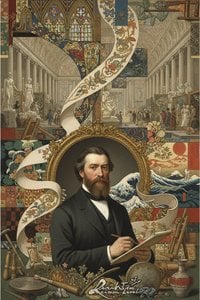
Friedrich Ritter von Amerling: A Master of Academic Portraiture
Friedrich Ritter von Amerling (b. 1803, Wien, d. 1887, Wien) stands as a prominent figure in Austrian art history, celebrated for his unwavering dedication to the academic tradition and his remarkable ability to capture the dignity and grace of aristocratic subjects during the Romantic era. Born into a family of craftsmen—a lineage that instilled within him an appreciation for meticulous detail and skillful execution—Amerling embarked on his artistic journey at the Akademie der bildenden Künste in Vienna, where he honed his talents under the tutelage of influential artists who championed classical ideals.
- Early Training & Influences: Amerling’s formative years were marked by exposure to the prevailing artistic sensibilities of his time, notably those espoused by William Adolphe Bouguereau, whom he regarded as a kindred spirit in prioritizing realism and compositional harmony.
- Landscape Painting Beginnings: Initially drawn to landscape painting—a genre favored by many Viennese artists—Amerling swiftly established himself as a proficient interpreter of the Austrian Alps and Danube Valley. His canvases conveyed not merely visual impressions but also an underlying sense of grandeur and spiritual contemplation.
The Pursuit of Academic Realism
Amerling’s artistic philosophy centered on achieving meticulous accuracy in portraying his subjects—primarily portraits of nobility—through painstaking observation and skillful technique. He adhered rigorously to the principles of academic painting, prioritizing anatomical correctness, idealized beauty, and a carefully constructed pyramidal composition. This commitment to tradition reflects the broader cultural climate of Vienna during the mid-19th century, where artistic excellence was inextricably linked to upholding established conventions.
- Notable Works: Among his most enduring achievements are portraits depicting figures such as Bertel Thorvaldsen—the celebrated sculptor—Ludmilla Amerling (his daughter), and numerous members of Viennese aristocratic families. These paintings exemplify Amerling’s mastery of chiaroscuro, utilizing subtle gradations of light and shadow to sculpt form and imbue his subjects with psychological depth.
- Technique & Style: Amerling's distinctive style was characterized by a deliberate restraint in color palettes—often favoring muted tones—and an unwavering focus on capturing the textures and nuances of skin, drapery, and hair. His meticulous brushwork contributed to the luminous quality of his canvases, creating images that resonate with timeless beauty.
Influence & Legacy
Friedrich Ritter von Amerling’s influence extended beyond his own oeuvre, shaping the artistic sensibilities of subsequent generations and solidifying the academic tradition's position within Viennese art. His unwavering devotion to classical ideals served as a counterpoint to emerging Impressionist tendencies, ensuring that realism and idealized beauty continued to hold sway in Austrian painting for decades afterward. Today, Amerling’s works reside primarily in museums across Europe—including Musée Maurice Denis in Paris—where they continue to inspire admiration for their technical brilliance and expressive power.
- Contemporary Comparisons: Comparing Amerling's work with that of Claude Monet or Pierre-Auguste Renoir reveals a fundamental divergence in artistic vision. While Impressionists sought to capture fleeting moments of sensory experience, Amerling prioritized conveying enduring qualities of character and dignity through meticulously rendered portraits.
Amerling’s legacy resides not merely in the beauty of his paintings but also in his steadfast defense of artistic integrity—a testament to the enduring power of tradition and the pursuit of excellence within the realm of visual art.